
The Founders of the Seventh-day Adventist Denomination
By , The American Sabbath Tract Society (Seventh Day Baptist) Plainfield, N. J.,
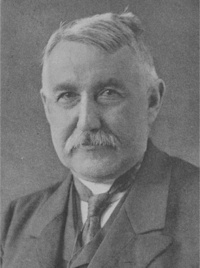
Divine truth rests upon the Bible, and if it alone is the rule and expositor, its sanctifying influence is quickly apparent in unity. Seventh Day Adventism is a rather strange mixture of a varied character, arising between 1840 and 1947. Its founders were William Miller, S. S. Snow, Joseph Bates, James White, Mrs. Ellen G. White, and –against his protest – O. R. L. Crozier, also. The most perplexing part lies in the visions of Mrs. Ellen G. White in which she quotes Christ and angels, and asserts herself as an infallible authority.
From a small beginning in the eastern part of the United States, the Seventh-day Adventist denomination has spread world-wide, now numbering about 425,000 members, and has a very extended literature in many languages. Personal and careful research among their own documents has fully persuaded me, after a long, active leadership among them, that it is my duty as a Christian and lover of divine truth to show the danger of their blending truth with error.
The True and a False Advent Hope
To look for the appearing of the great God and of our Savior Jesus Christ is a “blessed hope”, which redeems us from all iniquity, and purifies unto Christ as a peculiar people, zealous of good works (Titus 2:13-15). The Lord has charged his disciples to watch, pray, and be at all times prepared for his blessed return in glory.
Regarding the long time of waiting, which Jesus well fore-knew, he gave them sober, practical information in the parable of the Ten Talents, or Pounds. They should, in the most diligent manner, try to increase the talents entrusted to their care, so that when their master “after a long time” returns and makes a reckoning with them, they might be found faithful. (Luke 19:11; Matthew 25:19.) For certain events in the New Testament, the Lord has indeed given prophetic dates, but never for the advent of Christ. (Mark 13:32.) Thus the 1260 days in Daniel and Revelation play quite an important role. A century before the French Revolution, Bishop Fleming foretold, in 1701, that at their termination God’s judgments would begin to fall on the papal Babylon, and first on France, the eldest daughter of the Roman Catholic Church. When this was actually realized, Terry in London simply republished in 1793 the original edition as the best evidence. The spiritual leaders of Great Britain, convinced by the events in France of the certainty of the prophetic word, concluded that the downfall of the papacy would be followed by a similar wasting of the Turkish power, and thus a door would be opened for the circulation of the Bible in all tongues, and for the spread of the gospel in all the world. As precious fruit of this true advent movement in Great Britain, the nineteenth century became generally noted as “The Great Missionary Age.” By referring to the fulfillment of prophetic time, proved by historic events, the true advent hope in Great Britain produced most precious fruits of sanctifying influence. When William Miller, in New England, felt himself justified in fixing at the close of the 2300 year-days the coming of Christ “about the year 1843,” the opposite was the case, and great disappointment the grave result. Friends of prophecy in Great Britain warned Miller in vain. The Miller movement in the United States of America was in itself unbiblical; because, according to the definite declarations of our Lord Jesus, not the year, day, nor hour of his advent should ever be made known.
Unscriptural Definite Day Movements
Miller’s “about the year 1843” was already a serious blunder, doing much harm to the advent hope. As partial justification, he remarked in his Apology, of April 1, 1847, that some of his brethren had urged him to state the date more definitely, and had tried to make him feel that it was his duty to call the churches Babylon and to exhort men to come out of them.
With this I was much grieved, as not only was the effect very bad, but I regarded it as a perversion of the word of God – a wresting of Scripture. But the practice spread extensively, and from that time the churches, as might have been expected, were closed against us.On the passing of my published time, I frankly acknowledged my disappointment to the exact period, but my faith was unchanged in any essential feature.
Accordingly, in the summer of 1844, he toured the middle west with Editor Himes, who published the Advent Herald in Boston; and, with E. Jacobs, The Western Midnight Cry in Cincinnati. Eld. S. S. Snow used the occasion of their absence to launch for tarrying time a new slogan, “The Tenth Day of the Seventh Month, Year of Jubilee!” In his “True Midnight Cry” of August 22, 1844, (A Word to the Little Flock, p. 5) Snow perverted the sense of Mark, 13: 22, so that the Father would make known October 22nd (Karaite reckoning), as the date of Christ’s coming. As Ezra arrived on the first day of the fifth month at Jerusalem, it would leave him over two months for building preparations before the day of atonement; or, altogether, seven months of tarrying. (Olsen, p. 152.) How Snow secured his mistranslation, The Advent Harbinger and Midnight Alarm (Vol. II, No. 1), edited by R. Winter and F. Gunner in London, explains. Before I would state that Doctor Jarvis hailed from Middletown, Connecticut.
Under “Knowledge Shall be Increased,” Winter asserts:
In a late work of Dr. Jarvis’s (an acknowledged linguist), in opposition to our views, he gives the following correction of the English translation of Matt. xxiv, 36, ‘But of that day and hour maketh known, no man (instead of knoweth) no not the angels of heaven, but my father only.’ We have also consulted other unquestionable authorities, which confirm this criticism. This reading entirely alters the meaning of the passage, which has been the great weapon, offensive and defensive, of unbelievers. It is exactly opposite to the almost universal sentiment, that no one can ever know anything about the day or the hour, and unbelief which has been too long cherished, even by Adventists. (August 14, 1844, Vol. II, p. 7.)
Then Winter continues on the same pages, 7-8, under the heading “The Seventh Month”:
Since our devoted Bro. Snow has been with us, I have been led more seriously to consider the meaning of these shadows of things to come, and to understand that the body, or substance, is of Christ. When he was with his disciples, he taught them, that he came to fulfill the law, and that every jot and tittle must have its accomplishment. We find that the time and circumstances of his death, minutely correspond with the type of the paschal lamb, even unto the day, and the hour of the day, in which it was slain. If he accomplished such a definite fulfillment in his first Advent of the type before given, why should we doubt the conclusion that the types of the seventh month ‘CAN only have their fulfillment at his second coming?’ We have believed and fully expressed that the TIME is REVEALED, and that it is the duty of every one to search and understand, as the ancient prophets did. (See 1 Peter 1:11.) We should therefore, submit to the leadings of the Father’s unerring providence and follow Christ and his truth, and not settle down in the error of our opponents, and say the exact time is sealed, the prophetic mine exhausted, and wisdom must die with us. No, truly, for God hath appointed a day, in which he will judge the world, and of that day and hour maketh known, none save the Father, and the wise shall understand. Let us, then, look not back into Egypt, but listen to the voice from the pillar of fire, which reproves our sadness, saying, ‘wherefore criest thou unto me? speak unto the children of the Advent, that they go forward.’What shall we say then, if God and his truth are with us, who shall prevail against them? If these shadows are of Christ, his body will soon appear. Let us then follow on to know the truth, and if the vision tarry from the first, until the seventh month, let us wait for it, knowing assuredly that at the end, it will speak and not lie.
Then closing his chronology, Winter states:
To fall of Papal Rome………………… A. M. 5955, B. C. 1798To fall of Mohammedan Power… A. M. 5997, B. C. 1840
To the End ………………………………… A.M. 6000, B. C. 1843-4
When, on the 14th of September, Miller and Hines arrived from Ohio, they were hailed by 50,000 Adventists with the cry “The Tenth Day of the Seventh Month!” Fields were left unharvested, businesses were closed, trade neglected, and properties and belongings given away. Influenced by Snow, thousands had left their churches and were now indeed left in Babylon! In vain did Miller and Himes protest against Snow’s definite date. During the last two weeks they also yielded, so that on the 12th of October, Miller wrote to Himes:
I see a glory in the seventh month which I never saw before. Let Br. Snow, Br. Storrs, and others be blessed for their instrumentality in opening my eyes! Christ will come on the Seventh Month and bless us all. Oh, glorious hope! (Days of Delusion, by Clara Sears, p. 164, ff.)
As Miller had never planned to create a new denomination, the 50,000 Adventists were, on the 22nd of October, 1844, indeed as sheep without a shepherd. The Advent movement in Great Britain had, indeed, realized its noble object; namely, to increase spiritual life, to lead thousands to accept Christ as their Savior, to fulfill Matthew 24: 14 by calling into life Bible and mission societies, to make the best use of the open door (made free by the wasting of the papal and Turkish powers), and to strengthen faith in the prophetic word by pointing to the real fulfillment. The counterfeit American movement, proclaiming the door of grace shut forever, resulted, on the contrary, in disappointment and confusion as at the Tower of Babel, and did untold harm to faith in the prophetic word.
The Separation Between the Sober Majority of Adventists and the Fanatical Minorities
With the passing of the 22nd of October without the appearing of Christ, the influence of the fanatical Snow waned, because his “True Midnight Cry” had proven false. Most of the Adventists turned again to Miller, who at once exhorted them to stand fast, and showed his true greatness in the hour of failure. Himes, Bliss, and Hale, the editors of the Advent-Herald, tried on the 13th of November, 1844, to vindicate their position regarding 1843, and the tenth day of the seventh month in 1844, as far as possible.
‘As the law was a shadow of good things to come,’ as the crucifixion of Christ – the Paschal Lamb –‘our passover’, was on the very day of the Jewish Passover, as he arose the first fruits of those that slept on the day the priest waved before the Lord the first fruits of the earth for a wave offering, and as the Holy Spirit descended on the day of Pentecost – the feast of weeks; so we believed that our great High Priest, having entered the holy of holies, and sprinkled it with his blood, might come out of the same to bless his people, on the day that this great antitype was shadowed forth by the observances of the Jewish law. It being also at a point of time to which all the various periods might extend, and where they might terminate – we could not resist the conviction that it was the true view of the time … And yet we are disappointed … As great a paradox as it may be to our opponents, yet we can discern in it the leadings of God’s providence … we regard it as another and a more searching test than the first proclamation of the time. (Advent Review, 1850, No. 1, pp. 4-5.)
The Advent-Herald of October 30, 1844, says,
We must still regard it as the true midnight cry. And if we have a few days in which to try our faith, it is still in accordance with the parable of the ten virgins; for when they had all arisen and trimmed their lamps, there was still to be a time when the lamps of the foolish virgins would be gone out. This could not be without a passing by of the tenth day … A little delay is, therefore, no cause for discouragement, but shows how exact God is in the fulfillment of his work. Let us therefore hold fast the profession of our faith without wavering, for he is faithful who has promised.
Even with the majority of faithful Adventists and with William Miller himself, it took some months before they fully recovered from their erroneous views, that they had sounded the “true midnight cry.” In the Morning Watch, the successor of the Midnight Cry, Eld. J. V. Himes presented in its issue of February 20, 1845, under the title “Is the Door Shut?” an able argument of six points against this theory; and the article was reprinted in the Advent Herald of February 26. In the Advent Herald of March 5, Elder Himes wrote of the open door in Canada, stating, “Our brethren in this region are publishing a free and full salvation to sinners.” (Advent Christian History, Johnson, p. 194).
But in order to give a firm foundation again to the many Adventists who had been urged to come out of Babylon, a conference was called on April 29, 1845, at Albany, N.Y., William Miller being in the chair, the conference agreed that one of the most important duties of the ministers was “to preach the Gospel to every creature even unto the end.” As early as 1846, Elders Himes, Brown, and Hutchinson made an extended tour in Great Britain and formed an extensive acquaintance with the English leaders of the advent movement. Thus, at an early date the “Advent Christians” turned their attention to soul-winning and missionary work, stressing especially the doctrine of conditional immortality, or immortality only by faith in Christ.
A minority of Adventists still maintained that the call to come out of Babylon, stressed by S. S. Snow, was to be upheld, and that there was no salvation for sinners any more. As an additional proof, they pointed to the Levitical type in Leviticus 25:9-14, showing that after the sounding of the jubilee trumpet on the day of atonement, some time passed ere the captives were set free. Elder J. Marsh, who in his Voice of Truth maintained this view still longer, declared on November 7, 1844, that
We cheerfully admit that we have been mistaken in the nature of the event we expected would occur on the tenth day of the seventh month; but we can not yet admit that our great High Priest did not on that very day, accomplish all that the type would justify us to expect. We now believe he did.
About that time there appeared in the Voice of Truth a poem, entitled, “The Seventh Month,” signed by C. S. M.:
Upon the eternal rock among raging waves, a remnant, held, as it were, by an unseen power, braved the storm. But in a wild attempt to save their lives:“Some, that had been the foremost in the train,Rushed o’er the beetling verge of that high rock,
And loudly called upon the rest to turn.”
The application is very evident from the protest of Editor marsh, which he published on May 7 and 21, (Advent Review, Auburn, August, 1850, No. 2, pp. 607) against the proceedings of the Albany Conference forming a new sect, as follows:
“From this fallen city, brethren, we have fled, in obedience to the command, ‘Come out of her.’ Let us not go back to her polluted temples, nor build one of our own after any of her patterns. Obey Christ and his word, and you have nothing to fear; but if you depart from him, like the examples before us, he will cast us off forever.”
That S. S. Snow shared the views of Editor Marsh, we can infer from the title of his own paper, The Jubilee Standard. But what preposterous claims Snow put forth after his “True Midnight Cry” had proved false, statements in his book, The Voice of Elias, or Prophecy Restored, published August 5, 1863, clearly show. First regarding his own mission in the summer of 1844, then afterward, as follows:
But while they were slumbering on the subject of time, which was then so important and not realizing the nearness of the great event; in the summer of 1844, the midnight cry was sounded -- ‘Behold, the bridegroom cometh, go ye out to meet him.’ But who gave the cry? Not the virgins, wise and foolish, for they were slumbering. It could have been no other voice but that of Elias, the watchman, (Snow) who did not sleep upon his post. The time as proclaimed by that messenger, and proved by scripture and historical facts, was the tenth day of the Jewish month – the day of atonement and of the sounding of the trumpet of Jubilee in 1844. And true to that appointed time, the bridegroom came to the marriage. Our Lord and Savior took the throne of his everlasting kingdom, and is now the King of kings and Lord of lords. By the power of that cry the virgins were roused from their slumber, and arose and trimmed their lamps. In other words, the adventists, as they were called, began to prepare themselves, spiritually, for the Lord’s coming. While those elder brethren were going to get ready, the Master of the house arose and closed the door of the gospel dispensation. The only saving grace that can be obtained by God, since the passing of the that great crisis is through the dispensation of the fullness of times, or the restoration of all things, in the mission of Elias. (pp. 114-115.)
In these words, Snow not only tried to vindicate his Midnight Cry as the true one, but claimed that the bridegroom came to the marriage at the “appointed time,” October 22, 1844, and that the adventists as wise virgins prepared themselves “spiritually,” and with lamps trimmed went into the marriage, but the door was henceforth “shut” for all the foolish.
The First Vision of Ellen G. Harmon-White Confirms Snow’s “True Midnight Cry” as “The Work of God”
This vision of December 22, 1844 is given in full in Elder E. S. Ballenger’s reprint A Word to the Little Flock. Therefore, it suffices to take from it her statements, and to quote the testimony of James White (p. 22) regarding the effect of her first vision. William Miller had given a second course of lectures in Portland, Maine, already in 1842, with great success; and, among others, he won the hat-maker Harmon and his family, who had been formerly Methodists. Their daughter, Ellen, born November 27, 1827, being disabled by a stone in 1836, had but little schooling. Being of an hysterical nature, all the disappointments of 1843-44 had full effect upon her.[1] She had followed all the vindications of Snow’s “True Midnight Cry” by various writers ever since November 7, and considered them with her most intimate friend, Mrs. Haines. That the whole band at Portland lost faith in Snow’s “Midnight Cry” is easy to understand; also, how this hysterical girl, reading these vindications, should again come under Snow’s influence. But that her fanciful vision, which this seventeen-year-old girl claimed to have, while praying with four other women on the morning of December 22, 1844, at Mrs. Haines’ home, should exert such an influence upon the whole band, causes serious reflection. Notice the following points in her vision (A Word to the “Little Flock,” 1847, p. 14):
- The bright light, enlightening the Advent path ever since October 22, was according to the statement of an angel, Snow’s midnight cry.
- She makes use of Snow’s perversion of Mark 13:32, as Bible proof that the Father, with his own voice, will make known to the living saints the day and hour of Jesus’ coming.
- In harmony with Snow, only the 144,000 saints – including her – remaining on the path to the city, will see Jesus coming without seeing death. Only these 144,000 are allowed to enter the temple; their names only are engraved in letters of gold on tables of stone.
- Again, in full harmony with Snow’s teachings, the 144,000 were “by this time all sealed and perfectly united.”
- But the seal upon the whole evidence, James White furnishes in stating the result of the vision, as follows (p. 22):
When she received her first vision, December, 1844, she and all the band in Portland had given up the midnight cry, and shut the door, as being in the past. It was then that the Lord showed her in a vision, the error into which she and the entire band in Portland had fallen. She then related her vision to the band, and about sixty confessed their error, and acknowledged their seventh month experience to be the work of God.
Mrs. White’s Success in Relating Her Vision at Portland the Stimulus to Similar Attempts Elsewhere
The unexpected success of relating her fancied vision at Portland in reviving the lost faith in Snow’s Midnight Cry, and the shut door, in the hearts of sixty believers, naturally strengthened her own belief that “the power attending them could only emanate from the divine,” and that she was the chosen instrument of God to restore this confidence elsewhere. This is evident from her own statement under the heading “Call to Travel,” as follows:
I related this vision to the believers in Portland, who had full confidence that it was from God.” “An unspeakable awe filled me that I, so young and feeble, should be chosen as the instrument by which God would give light to his people.” “In a second vision, which soon followed the first, I was shown the trials through which I must pass, and that it was my duty to go, and to relate to others what God had revealed to me.” “The way providentially opened for me to go to the eastern part of Maine … At Orrington, I met Elder J. White. (Testimonies, Vol. I, pp. 62, 65.)
At an early date, Mr. and Mrs. White supplied their biographies in various books. Later, J. N. Loughborough wrote a history of the Rise and Progress of The Seventh Day Adventists[2], in which both Elder and Mrs. White play the prominent role; and finally, Professor M. E. Olsen, under the careful supervision of Elder Spicer, has filled a volume of 768 pages, describing the Origin and progress of the Seventh Day Adventists. In this work is fully stated that Elder White was born at Palmyra, Maine, August 4, 1821, that Miss Ellen G. Harmon, who subsequently became his wife, met him during the early part of 1845, at Orrington, Maine; also, that in the spring of 1845, they had a wonderful experience together in the house of Elder Curtis, in Topsham, Maine; and that both traveled together a great deal during 1845, in Maine, New Hampshire, and Massachusetts.
According to Life Sketches, pp. 126-127, James White first met Miss Harmon in Portland in 1843:
Although but sixteen, she was a labourer in the cause of Christ in public and from house to house. She was a decided Adventist. Our meetings were usually conducted in a manner so that both of us took part. I would give a doctrinal discourse, then Mrs. White could give an exhortation of considerable length, melting her way into the tenderest feelings of the congregation.
Snow Fixes the Jewish Atonement Day in 1845 as the “Blessed” Day of Christ’s Advent; and James White, with Many Others, Announces It
By what means Snow extended the advent beyond October 22, 1844, his notes on Daniel 12:11-12, show:
Paganism was removed when the barbarians turned Christian in name, and began to unite in giving their power in support of the papacy. Clovis, the king of the Franks, was the first of the kings who was baptized into the Romish religion. He was made consul of Rome by the pope in A.D. 510, and from that time onward the kingdom of France had been called the ‘Eldest Son of the Church.’ Daniel 12:12. This period dates from the same point as the other, for that is the only point given. And from 510 A. D., the latter reaches to 1845. And what then? The next verse informs us what then begins; namely, the manifestation of the Children of God, of whom there are two classes – the First fruits, and the full ingathering of the harvest.This great work of manifestation began in the autumn of 1845, when the leader of the living church, who is sent in the spirit and power of Elias to prepare the way of the Lord before him, was first made manifest to the true Israel of God … A 144,000 living saints will stand on Mount Zion, singing the new song, which none can learn to sing but they; and all will be waiting for the blessed Jesus. (The Voice of The Prophet Elijah, New York, 1864, pp. 79-80.)
Then again, on p. 157, he says,
Therefore this sealing process speedily followed the close of the gospel age. Or, to be more definite, all the times given in prophecy had closed in the seventh month of 1844 with the single exception of the 1335 days of Daniel 12:12, which ended at the commencement of the seventh Jewish month 1845. Within the year elapsing between those two points of time, the sealing was accomplished; and then immediately began the manifestation of those sealed ones who are to be alive and remain until our Lord’s personal appearing.
But did James White, with many other Adventists, accept this view of Snow? And what evidence does he simply give that he himself proclaimed such a message?
Note the following:
It is well known that many were expecting the Lord to come at the seventh month, 1845. That Christ would then come, we firmly believed. A few days before the time, I was at Fairhaven and Dartmouth, Massachusetts, with a message on this point of time. (A Word to The Little Flock, p. 22.)
This short statement, purporting to be a proof in favor of Mrs. White’s visions, never appears after May 30, 1847, in any of the books or papers published by the Seventh-day Adventists. According to it, Eld. James White, in full harmony with Snow, was announcing in Dartmouth and Fairhaven (where Bates lived) that within a few days all those who awaited the Lord would see their expectation realized. His beloved Ellen is relating, at the same time, her visions at Carver, Massachusetts, with the usual success. Only “a few days” remain before this new date would expire. But no voice of God had thus far announced the definite day to the saints, no special tribulation had befallen them; and, in view of all this, she dares to inform him that he would, with all the many other Adventists, again be disappointed! Why did she not, long before this, tell him and all those others who were again deceived by Snow that the Saviour had denounced time-setting? Simply because she herself believed that Snow’s perversion of Mark 13:32 was justifiable. Even as late as May 30, 1847, James White endorsed Snow’s statement in the “True Midnight Cry” of August 22, 1844, as follows:
I believe the above, to be a fair and correct view of the subject, and that the Father will make known the true time of the advent without the agency of men, angels, or the Son. (A Word to the Little Flock, p. 5.)
When, in spite of all the results of her pretended visions – which were published by Jacobs in January, 1846, she found herself in this new dilemma; it was then and there that Crozier, by his hypothesis in the Day-Star of February 7, 1846, supplied the much-desired remedy.
Crozier, Since 1845, Editor of the “Day-Dawn” at Canandaigua, New York
Beginning with February 18, 1845, E. Jacobs, of Cincinnati, changed the title of his paper, which had been The Western Midnight Cry. On the strength of 2nd Peter, 1:19, he henceforth called it The Day-Star. In this first number, he published his letter to Elder G. Storrs, one of the advent leaders, who was extensively known for his six sermons on conditional immortality. He chided Storrs for suddenly turning about after the disappointment, and pronouncing the fixing of a definite day or year for the advent, a delusion. At that time, Jacobs himself, with others, still clung to the idea that the delay of the advent might be explained by the tarrying of the year of jubilee. In his number of April 15, 1845 (p. 36), he writes, as follows:
The first number of a second Advent paper has come to hand, called the Day-Dawn. It is published at Canandaigua, N. Y., by Franklin B. Hahn, and edited by O. R. L. Crozier. It is written in a good spirit, — the sentiments differing but a little from those of Br. Hale, The Jubilee Standard, and The Hope of Israel.
My research in the library at Canandaigua, in August, 1930, brought no result, not a copy of the Day-Dawn could be found. But the favorable editorial of Jacobs concerning the first number justifies the conclusion that, in the beginning of 1845, Crozier’s train of thought coincided with that of Hale, Marsh, Snow, and White. This is confirmed by the fact that, as late as 1850, White and Edson published in the Advent-Review all these “Thrilling testimonies,” as they also published Jacobs’ letter to Storrs, all to justify their own view. After the disappointment in the fall of 1845, many were tempted to “believe that Christ’s second coming at the end of 2300 days was a spiritual coming.” (Loughborough, p. 108.) Among these, was E. Jacobs, also, who gradually turned Shaker. In their Testimony of Christ’s Second Appearing, the Shakers teach that Christ was incarnated in their prophetess, Ann Lee, who called herself “Ann the Word.” The Shakers practice celibacy, and have formed a number of settlements in Mount Lebanon, Oneida, etc.
When and Why Was Mrs. White’s First Vision Printed in the “Day-Star”?
To this pertinent question, James White gives the desired answer in his pamphlet (p. 13) of May 30, 1847, as follows:
The following vision was published in the Day-Star more than a year ago. By the request of friends, it is republished in this little work, with scripture references, for the benefit of the little flock.
Ellen G. Harmon, evidently a reader of the Day-Star, and perceiving that E. Jacobs, in his paper, showed a tendency towards Shakerism, sent her first vision (which she had on December 22, 1844) to him, hoping that thereby she might influence him to believe her visions, rather than those of, “Mother Ann.” It was altogether a private matter. She had not the least thought that her, thus far, unpublished vision would be printed by Jacobs in the Day-Star, of January 24, 1846, and thus any future change of the wording would be detected at once. But how little effect her first vision had upon Bro. Jacobs as a “Testimony from God,” her own words (Early Writings, pp. 66-67) demonstrate, as follows:
I have frequently been falsely charged with teaching views peculiar to spiritualism. But before the editor of the Day-Star ran into that delusion, the Lord gave me a view of the sad and desolating effects that would be produced upon the flock by him and others, in teaching the spiritual views. I have often seen the lovely Jesus, that he is a person. I asked him if his Father was a person and had a form like himself. Said Jesus, ‘I am in the express image of my Father’s person.’I have often seen that the spiritual view took away all the glory of Heaven, and that in many minds the throne of David and the lovely person of Jesus have been burned up in the fire of spiritualism.
This statement is very strange indeed; because, in her first vision which she sent to Jacobs on December 24, 1845, she does not reprove him in any wise, nor point out “the sad and desolating effects of his spiritualism.” Her pretension to have “often” seen that Jesus is a “person,” written so shortly after sending him her first vision, is surely exaggeration. But when she directed her closing words to the “Dear Reader” in 1851, the editor of the Day-Star had already become a Shaker; for, since the fall of 1846, his paper had appeared in the Shaker settlement of Oneida, not far from Canandaigua; and he had succeeded in drawing after him a considerable number of Adventists. Thus, in 1851, she clothes her first vision with the appearance of a testimony for Jacobs, of which not the least trace exists. Barely had she sent her first vision to Jacobs to enlighten him; and scarcely had he, altogether unexpected by her, printed it in the Day-Star of January 24, 1846, when, on February 7, following, to her great embarrassment, the hypothesis of Crozier appeared in the same paper, suggesting an altogether different solution of the disappointment of 1844-1845.
Crozier’s Complete Pamphlet for 70 Years a Riddle, but Urged by Mrs. White and Seventh-day Adventists as Infallible Light
Strange things happen also in the religious world. A simple Bible study demonstrates, that when Christ did reconcile the sin-cursed world with one sacrifice at the cross, and ascended to the right hand of the divine majesty as Lord and high priest after the everlasting order of Melchizedek, the most holy in the heavens was forever cleansed and justified. (Lev. 16:15-19; Dan. 9:24; Hebr. 9:26; 10:19-20). This was the general belief of all sincere Christians. When in Great Britain, after the expiration of the 1260 years, about 1793, and also the expiration of the 2300 years about 1844, were urged, it was ever in the sense that the sanctuary would be “justified”, its honor saved against perverted use (niphal from tsdak, to be made righteous; see Melchizedek, king of righteousness). William Miller, on the other hand, not knowing Hebrew, taught that in 1843 the world would be cleansed by fire. As that prophecy failed, S. S. Snow taught that on October 22, 1844, Christ would come, after having entered the most holy at that time. As 50,000 Adventists erred in 1844/45, finally Mrs. White, in her letter to Eli Curtis, on April 21, 1847, made this wild assertion as an infallible vision:
I believe the sanctuary, to be cleansed at the end of the 2300 days, is the New Jerusalem Temple, of which Christ is a minister. The Lord shew me in vision, more than one year ago, that Bro. Crozier had the true light, on the cleansing of the sanctuary etc.; and that it was his will, that Br. C. should write out the view which he gave in the Day-Star, Extra, Feb. 7, 1846. I feel fully authorized by the Lord, to recommend that Extra to every saint. (A Word to the Little Flock, p. 12).
After such an introduction, under the conviction that the reprint in the Review was “reliable and quite complete”, as editor of the German Seventh-day Adventist Adventbote, I published it during the winter of 1929-30. When, in the second reprint, I found one important paragraph missing, I notified Eld. W. C. White of the fact, who in 1931, sent out, from “The Elmshaven Office”, St. Helena, California, this reprint with this paragraph as “The Article Unabridged.” But some omissions marked by stars towards the end caused me to hunt for the original, but in vain. However, I found other important material, also Crozier’s photograph, and in article written by him as late as 1900. Encouraged by my researches, Eld. L. E. Froom (editor of The Ministry, Advent Review Office, Washington, D. C.), having more time, finally succeeded in finding an original copy in the library at Cleveland, Ohio.
From Elder Froom, I learned the following important facts about Crozier’s life:
O. R. L. Crozier was born February 2, 1820, at Chapinville, Ontario County, New York. He attended the Genesee Academy two years, the Wesleyan Seminary at Lima two years, and the University of Rochester two years. He became a teacher, holding different positions until he joined the Miller movement. Following 1846, he preached in New York, Canada, Michigan, Ohio, and Indiana, at various times. This information is based upon the story of his life that he wrote ten years before his death, which occurred in 1913.
After a carefully corrected copy of Crozier’s pamphlet was finally found, Elder Ballenger kindly supplied me with a photographic reprint of it. It is found as “Extra” in Vol. IX of the Day-Star, pp. 37-44. Upon each page there are 3 columns, but upon the last page only 2. Instead of being headed “Sanctuary”, it is headed: “The Law of Moses, Mal. 4:4.” As the Day-Star of Jacobs had a far greater circulation than the small sheet the Day-Dawn, Crozier, after finishing the manuscript on January 17, sent it on to Jacobs, who published it as a Day-Star, Extra, on February 7. Note the following:
'Remember ye the law of Moses, my servant, which I commanded unto him in Horeb for all Israel, with the statutes and judgments.' Malachi 4:4.The Law should be studied and ‘remembered’ as a simplified model of the great system of redemption, containing symbolic representations of the work begun by our Savior at his first advent when he ‘came to fulfill the law’ and to be completed in ‘the redemption of the purchased possession unto the praise of his glory.’ Redemption is deliverance purchased by the payment of a ransom, hence it can not be complete till man and the earth shall be delivered from the subjection and consequences of sin; the last act of deliverance will be at the end of 1000 years. To this the shadow of the law extended. That the significance of the Law reaches beyond the first advent is evident from these considerations:
- The cleansing of the sanctuary formed a part of the legal service (Leviticus 16:20, 33) and its antitype was not to be cleansed till the end of the 2300 days, Daniel 8:14.”
- The Sabbaths under the Law typify the great Sabbath, the seventh Millennium. Hebrews 4:3.”
- The Jubilee typifies the release and return to their possessions of all captive Israel; this can not be fulfilled till the resurrection of the just.”
- The autumnal types were none of them fulfilled at the first advent.”
- The legal tenth day atonement was not, neither could it be, fulfilled at that time. Although he blotted out the handwriting of ordinances that were against us … and took it out of the way, nailing it to his cross, yet, after his resurrection, both he and his apostles made use of the law in proof of his Messiah-ship. He was buried and arose, and shed down the Holy Ghost in direct fulfillment of the types.
After showing the fulfillment of the vernal types, Passover and Pentecost, in the days of Christ, he next claims that the period of the fulfillment of autumnal types “must constitute a dispensation of many years,” the principal fulfillment taking place in the “age to come” during the millennial reign of Christ with his saints upon this earth. Imbued already with the false premises of the whole Miller movement, that the time prophecy in Daniel 8:14 was identical with the typical annual cleansing of the earthly sanctuary, he draws from it his false hypothesis: That at the end of 2300 evenings and mornings the final atonement and cleansing would take place as antitype; but links with it the idea that with the first resurrection the jubilee year would set in, and the millennial reign of Christ upon this earth. With these false premises, Crozier began his arguments, from which he drew his false conclusion at the end, if all the autumnal typical Sabbaths did not meet their antitype until many years after, even in the “age to come,” then so also would the Sabbath of atonement. It was a 11 or none! Crozier had, with his article in the Day-Star of February 7, 1846, found a way out of the dilemma, but on such a questionable hypothesis that James White and Hiram Edson, in 1850, had to cut off its head and tail before it suited their perverted purpose!
Vain Pretense of a Supplement and of an Earlier Vision
On January 24, 1846, Jacobs published the first vision of Ellen G. Harmon-White. On February 7, following, he published Crozier’s hypothesis, and on February 15, Miss Ellen G. Harmon, in consultation with her fiancé, James White, had fully decided how to word the document which should save her reputation as a prophetess, in the eyes of Jacobs and the readers of the Day-Star. As valid proof, I publish in full her second letter which she sent to Jacobs. I found it after a second visit to Cincinnati, September 24, 1932, in the Archaeological Library (University). In order that it may be easily seen how Mrs. White later mutilated part of that letter, making an actual vision, but without date (Experiences and Views, pp. 45-46), out of it, the omissions are in black fact type, her reprint in the usual type!
Letter from Sister Harmon, “Falmouth, Mass., Feb. 15, 1846
Bro. Jacobs,My vision which you published in the Day-Star was written under a deep sense of duty to you, not expecting you would publish it. Had I for once thought it was to be spread before the many readers of your paper, I should have been more particular and stated some things which I left out. As the readers of the Day–Star have seen a part of what God revealed to me, and as the part I have not written is of vast importance to the Saints; I humbly request you to publish this also in your paper. God showed me the following, one year ago this month: I saw a throne and on it sat the Father and his Son Jesus Christ. I gazed on Jesus’ countenance and admired his lovely person. The Father’s person I could not behold, for a cloud of glorious light covered him. I asked Jesus if his Father had a form like himself. He said he had, but I could not behold it; for, said he, if you should for once see the glory of His person, you would cease to exist. Before the throne was the Advent people, the Church and the World. I saw a company bowed down before the throne, deeply interested, while most of them stood up disinterested and careless. Those who were bowed down before the throne would offer up their prayers and look to Jesus, then he would look up to his Father and appeared to be pleading with him. Then a light came from the Father to his Son and from him to the praying company. Then I saw an exceeding bright light come from the Father to the Son and from the Son it waved over the people before the throne. But few could receive this great light. Many came out from under it and immediately resisted it. Others were careless and did not cherish the light and it did move off from them. Some cherished it and went and bowed down before the throne with the little praying company. This company all received the light, and rejoiced in it, as their countenances shone with its glory. Then I saw the Father rise from the throne and in a flaming chariot go into the Holy of Holies within the vail, and did sit. There I saw thrones which I had not seen before. Then Jesus rose up from the throne, and most of those who were bowed down rose up with him. And I did not see one ray of light pass from Jesus to the careless multitude after he rose up, and they were left in perfect darkness. Those who rose up when Jesus did, kept their eyes fixed on him as he left the throne, and led them out a little way, then he raised his right arm and we heard his lovely voice saying, Wait yet, I am going to my Father to receive the kingdom; keep your garments spotless and in a little while I will return from the wedding and receive you to myself. And I saw a cloudy chariot with wheels like flaming fire. Angels were all about the chariot as it came where Jesus was; he stepped into it and was borne to the Holiest where the Father sat. Then I beheld Jesus as he was before the Father a great High Priest. On the hem of his garment was a bell and a pomegranate. Then Jesus showed me the difference between faith and feeling. And I saw those who rose up with Jesus send up their faith to Jesus in the Holiest and praying: Father, give us thy spirit. Then Jesus would breathe on them the Holy Ghost. In the Breath was light, power and much love, joy and peace. Then I turned to look at the company who were still bowed before the throne. They did not know that Jesus had left it. Satan appeared to be by the throne trying to carry on the work of God. I saw them look up to the throne and pray: My Father give us thy spirit. Then Satan would breathe on them an unholy influence. In it there was light and much power, but no sweet love, joy and peace. Satan’s object was to keep them deceived and to draw back and deceive God’s children. I saw one after another leave the company who were praying to Jesus in the Holiest, go and join those before the throne and they at once received the unholy influence of Satan.
About four months since, I had a vision of events, all in the future. And I saw the time of trouble, such as never was, -- Jesus told me it was the time of Jacob’s trouble and that we should be delivered out of it by the voice of God. Just before we entered it, we all received the seal of the living God. Then I saw the four angels cease to hold the four winds. And I saw famine, pestilence and sword rose against nation, and the whole world was in confusion. Then we cried to God for deliverance day and night till we began to hear the bells on Jesus’ garment. And I saw Jesus rise up in the Holiest, and knew our High Priest was coming out. Then we heard the voice of God which shook the heavens and earth, and gave the 144,000 the day and hour of Jesus’ coming. Then the saints were free, united and full of the glory of God, for he had turned their captivity. And I saw a flaming cloud come where Jesus stood and he laid off his priestly garment and put on his kingly robe and took his place on the cloud, which carried him to the east where it first appeared to the saints on earth, a small black cloud, which was the sign of the Son of Man. While the cloud was passing from the Holiest to the East which took a number of days, the synagogue of Satan worshipped at the Saints’ feet.
Ellen G. Harmon.
Examination of Both Original Letters
The first original letter of Miss Ellen G. Harmon to Jacobs is contained in Elder E. S. Ballenger’s reprint (A Word to the Little Flock, pp. 14-16), where also all later omissions are shown in different type. She had her first vision of a heavenly sanctuary on December 22, 1844; and, according to this vision of February 15, 1846, the Father and Son had moved their thrones from the holy to the most Holy already on October 22; and, according to the later visions, the solemn investigative judgment was in full operation. But somehow Jesus had ample time to take her about the City, to lift the curtain hiding the most Holy. There she beholds two bright angels over the ark, Jesus lifts the cover. She sees nothing but manna and various well tasting fruits, which, after Jesus bore a part to the City, was fully replaced! That such a tale sent by her to Jacobs on December 20, 1845, and published by him in the Day-Star of January 24, 1846 did need a supplement from her pen on February 15, after Crozier’s article had appeared on February 7, nobody doubts! She was in a great predicament, and her second original letter shows how quickly, with the counsel of her fiancé, she found a way out. By calling attention to several different points, the examination will be helped, as follows:
- The decisive vision, entitled “End of the 2300 Days,” does, not only lack the date, but appears among visions of as late a date as September, 1850. Only the finding of the date in the original print enabled me to ascertain that, at the earliest possible moment after
reading Crozier’s article, she wrote the supplement, and sent it to Jacobs at once. Not only was the date omitted later; but every clue, also, that it was indeed a supplement.
- If Miss Harmon had already seen in a vision a year previous, i.e., February, 1845, Christ entering the Most Holy, why did she withhold such important light from her fiancé and from all other Adventists, who expected their Savior anew in October, 1845, and thereby avoided another bitter disappointment?
- Why does she mention this vision only in this original letter, in order to make Jacobs think that she had the light on the sanctuary before Crozier, and yet in all her numerous later writings never mentioned such an important vision at such an early date? Simply because it was a false vision, invented by her to fit the hypothesis of Crozier.
- Matters of vast importance to the Saints, which she withheld in the wording of her first vision, had thus to be supplemented.
- Where is it written in the Levitical law that, while the service in the Holy Place was going on, the mercy seat and God’s throne between the Cherubim (Exodus 25:18-22) stood in the Holy Place; and then, on the day of atonement, were removed by chariots to the Most Holy?
- That Satan could dare to take possession of the throne left empty, and could deceive most of the Adventists, puts the Adventists in the worst light; for, since Christ’s ascension, all Christians direct their petitions to a Saviour who sits in royal majesty at the right hand of God. As king, priest, after the order of Melchizedek, since his ascension, he wears the royal purple, and needs no change of garment.
- The real fact is, that Miss Harmon, with her fiancé, ingeniously so mutilated the wording of the original that, as a result, only a vision, entitled “End of the 2300 Days,” was cut out, without date and without clue to the circumstances of its peculiar origin. Immediately following the second letter of Miss Harmon in the Day-Star of March 14, there follows a letter written by Crozier under date of February 21, wherein he acknowledges the receipt of the Day-Star Extra, and says, “We are suited. It however has several typographical errors.”
James White Launches the First Vision of Mrs. White as an Experiment
As both letters of Ellen G. Harmon-White, with her first vision and with the additional vision in the supplement, had been printed in January and February, 1846, in the Day-Star, there existed no actual reason to publish 250 copies of her first vision in April. From the statement, however, of Brother Gurney, who shared the expense with James White, made in the Review in 1891, it is evident that it was an experiment to settle how the visions of his fiancé would be looked upon; and for such a test, the contents of her first vision seemed the better adapted. H. S. Gurney stated,
A small edition of about 250 copies was printed in Portland, Me., on a foolscap sheet, and circulated among the few believers and honest ones. The last page of the sheet was left partly blank, so that those receiving this document should have a place to write out their opinion of the same whether favorable, or unfavorable, and then return to the publisher, if they wished. Eld. J. White was the publisher, and Br. H. S. Gurney (this writer), now at Memphis, Mich., stood half of the expense of printing. (The total cost was $15.00.)(Signed) H. S. Gurney.
Whilst the small circle was sounded by James White regarding their attitude to the visions of his fiancé, Crozier wrote a letter to Jacobs from Oswego on March 31, showing great concern that his treatise might be correctly understood. Jacobs published his letter in the Day-Star of April 18, as follows:
Many seem not to have discovered that there is a literal and a spiritual temple, the literal being the Sanctuary in New Jerusalem (literal city); and the spiritual the church – the literal occupied by Jesus Christ, our King and Priest (John 14:2; Hebr. 8:2; 9:11) – the spiritual by the Holy Ghost (I Cor. 3:17; 6:19; Eph. 2:20, 22). Between these two there is a perfect concert of action, as Christ ‘prepares the place,’ the Spirit does the people. When he came to his temple, the Sanctuary, to cleanse it; the Spirit commenced the special cleansing of his people. Mal. 3:1-3. It is no marvel to my mind that many of our dear brethren and sisters in the absorbing sweetness and glory of the latter house, have lost sight of the former. Yours in love, O. R. L. Crozier.
How near Crozier approached to the right explanation of Daniel 8:11 ff.; 11:30 ff., to the effect that the question at issue in Daniel 8:14 was not an antitypical atonement, answering to the typical of Leviticus 16, but the cleansing of an earthly temple, polluted by idolatry, corresponding with 2nd Chronicles, 29, is seen from that paragraph of his treatise which the Seventh-day Adventists intentionally left out without any asterisks, as follows:
In this sense this ‘politico-religious beast’ polluted the Sanctuary (Rev. 13:6) and cast it down from its place in heaven (Ps. 102:19; Jer. 17:12; Hebr. 8:1-2) when they called Rome the holy City, (Rev. 21:2) and installed the Pope there with the titles ‘Lord God the Pope,’ ‘Holy Father,’ ‘Head of the Church,’ and there in the counterfeit ‘temple of God,’ he professes to do what Jesus actually does in his Sanctuary; (2nd Thess. 2:1-8). The Sanctuary has been trodden under foot (Dan. 8:13), and the same as the Son of God has (Heb. 10:29).
How anxiously Doctor Hahn, and Crozier still more, endeavored in April, 1845, to impress the brethren with the continuation of all the ceremonial Sabbaths as stressed on the first four pages of his treatise, and not only of the atonement Sabbath, is attested by a letter which Doctor Hahn sent from East Hamilton, New York, under date of April 15, as follows:
Dear Br. Jacobs: If there is room in your little sheet, I wish to lay before the brethren a few thoughts on the antitypes of the autumnal type: the memorial of trumpets, the tenth day of the seventh month, the trumpet of the jubilee on the 49th day of atonement, the jubilee year during the 1000 years and the feast of tabernacles.
Jacobs fulfilled the wish in the Day-Star of May 16 (p. 46 f.). By August, 1846, Jacobs, on his way to the Shakers, stopped at Canandaigua, where he was entertained by Dr. W. C. Sweet. A meeting was called to consider the difference between Jacobs and Crozier, to which "a number of brethren came from a distance.” Doctor Hahn, as chairman, stated that the meeting was free to all. Jacobs then pleaded for a union with the Shakers, causing quite a split; but “most of the brethren stood upon the same ground with Crozier.” He then issued a second number of the Day-Dawn, seemingly after a long interruption; and, in a lengthy article, entitled “Visit to the Shakers,” warned against the pernicious influence of Jacobs.
“The Opening Heavens,” By Joseph Bates
Two leading motives guided Bates in publishing this pamphlet of forty pages in New Bedford, Maine, by Lindsay:
- First. The truth of God to encourage the believer; and
- Second. To rebuke the spiritual views of Christ’s advent.
After twenty-one years of observation and experience, but especially during the last seven years as an associate of William Miller making great sacrifices, he felt it his duty to send forth this tract, May 8, 1846, after having read Crozier’s article in February, and after hearing of Jacob’s tendency to Shakerism. As a sea captain, he had become a lover of astronomy. As to the contents of the pamphlet, the following short survey will give us an insight, and the first pages will demonstrate that he differed widely from the present views of Seventh-day Adventists:
Pp. 1-5. The Opening Heavens proven from John 1:51. Christ come from the same place as that he went to, and he stands in the same place. He is now about to come with the Holy City, the capital of his everlasting kingdom, and locate in the ‘midst’ of the promised land, where he was crucified.Pp. 6-12. Astronomical view: Ferguson, Huyghens, William Herschel, Lord Rosse’s monster telescope.
Pp. 12-23. Bible view: “Then God and Christ and immortal saints constitute the Temple in this glorious City of Zion.”
Pp. 23-25. The Heavenly Jerusalem. The City lies 1500 miles square. Before he begins to consider the Sanctuary, pp. 25 onward, he recommends Crozier’s article, as follows: “But allow me first to recommend to your particular attention, O. R. L. Crozier’s article in the Day-Star Extra, for the 7th of February, 1846, from the 37-44th page. Read it again. In my humble opinion, it is superior to anything of the kind extant.”
After having considered the Daily and the 2300 days, he devotes nearly the whole of p. 35 to the Sabbath question. He says,
I wish here to ask a few questions on one of the greatest errors that the world ever embraced, first established by Pope Gregory, A. D. 603. I mean the changing of God’s seventh day Sabbath, (for it is sheer sophistry to call it the Jews’ Sabbath, as Jesus, our divine Lord, says ‘it was made for man’), to the first day of the week.
In closing, he declares that, when the sealing angel will have done his work, God will roar out of Zion, and Jerusalem, according to Joel 3:16-17,
will be cleansed from every impurity. This, I think, will be the shaking of the powers of heaven; for then will God’s people know that he dwells in Zion, not in the Shakers’ camp, but in his heavenly sanctuary.This then is the capacious and glorious ‘golden city’; ‘the new Jerusalem’; ‘The heavenly Sanctuary’ . . . the Capital of our coming Lord’s everlasting kingdom, which is now about to descend from the ‘third heaven’ by way of the open door, down by the ‘flaming sword’ of Orion!
How Did the Sabbath Gain a Footing Among the Seventh-day Adventists?
Already the first tract of Bates deals (p. 35) with the Sabbath question. According to the admission of Seventh-day Adventists (Loughborough, p. 109; Olsen[3], pp. 182 ff.), Sabbath tracts distributed by a Seventh Day Baptist sister among the Adventists in the spring of 1844, were the first cause. Throughout the Christian Era, there have always been Christians, who in the light of their Bibles felt under obligation to keep the Sabbath instituted by Christ at creation.
During the Reformation, a considerable number of Baptists began to defend the Sabbath truth in spite of the most severe persecution. After some of them had found a place of refuge in Rhode Island, the first Seventh Day Baptist Church in America was founded in Newport, on December 21, 1671, (Old Style). German believers began to observe the Sabbath in Germantown, Pennsylvania, as early as 1694. In 1728, the first German tract on the Sabbath was printed by Beissel, in Philadelphia. About the year 1800, there were 1200 Seventh Day Baptists in the eastern states; but, by 1841, their numbers had increased to 5319 members (Seventh Day Baptists in Europe and America, Vol. II, p. 1312), and they were so active that, in 1843, it was voted to “send an address to our brethren of the Baptist denomination, urging them to examine the subject of the Sabbath,” and, in 1844, “to all First-day Evangelical denominations in America.” In March, 1844, Rachel Preston, a Seventh Day Baptist, visited her brother-in-law, C. Farnsworth, in Washington, New Hampshire, and her Sabbath tracts caused forty Adventists to keep the Sabbath. On February 23, 1843, in Hope of Israel, the Adventist preacher, T. M. Preble, began to defend the Sabbath, as did J. B. Cook in Advent Testimony about the same time; but both soon ceased such efforts. However, J. Bates had his attention directed, by Preble’s article, to Tract No. 4, published by the Seventh Day Baptist Tract Society. Finding that Pope Gregory had urged the change of the Sabbath, he touched upon the Sabbath in his first tract, Opening Heavens, and led out in its defense. He tells how he related himself to the visions of Ellen G. Harmon, (A Word to the Little Flock, p. 21), as follows:
It is now about two years since I first saw the author, and heard her relate the substance of her visions as she has since published them in Portland (April 6, 1846). Although I could see nothing in them that militated against the word, yet I felt alarmed and tried exceedingly, and for a long time unwilling, to believe that it was anything more than what was produced by a protracted debilitated state of her body.” “During the number of visits she has made to New Bedford and Fairhaven since, while at our meetings I have seen her in vision a number of times, and also in Topsham, Me.; and those who were present during some of these exciting scenes know well with what interest and intensity I listened to every word, and watched every move to detect deception or mesmeric influence.
“The Seventh Day Sabbath a Perpetual Sign”
In August, 1846, Bates published a treatise of 48 pages, wherein, in detail, he considered the institution of the Sabbath in paradise, its continuation, and the difference between the Moral and the Ceremonial Law. In this treatise he also touches the three-fold message, (p. 24) in the following statement:
In Rev. 14:6-11, he saw three angels following each other in succession: 1. One preaching the everlasting Gospel (Second Advent doctrine); 2. Announcing the fall of Babylon; 3. Calling God’s people out of Babylon by showing the awful destruction that awaiteth all such as did not obey.” “Now it seems to me that the seventh day Sabbath is more clearly included in these commandments than Thou shalt not steal, kill, nor commit adultery, for it was the only one that was written at the Creation or in the beginning. He allows no stopping place this side of the gates of the City.
On p. 32, Bates stresses that the Sabbath begins at 6 o’clock in the evening; and that this day might also have its full twenty-four hours, the time must be established “from the center of the earth, the equator, where the sun rises and sets at 6 o’clock.” As a result, the Seventh-day Adventists, for quite a number of years, thus kept the Sabbath, differing from the Seventh Day Baptists, who keep it from sunset to sunset. On p. 34, he expresses his great regret that Father Miller, from whom he had received such a flood of light, should have declared in his lecture on the great Sabbath, “That the proper Creation Sabbath to man comes on the first day of the week.” On p. 40, he states that Brother Marsh, in his Voice of Truth, takes the ground with the infidel that there is no Sabbath. After having on p. 36 shown what a strange position Snow took in 1845 in his Jubilee Standard, he reveals his character, on p. 40, thus:
Br. S. S. Snow of N. Y., late editor of the Jubilee Standard, publishes to the World that he is the Elijah, preceding the advent of our Saviour, restoring all things: (the seventh day Sabbath must be one of the all things), and yet he takes the same ground with Br. Marsh.
Shortly after the publication of this Sabbath pamphlet, James White and Ellen G. Harmon were married, on August 26, 1846. At that time scarcely one hundred Adventists kept the Sabbath. How she related herself to the Sabbath at first, her own words prove (Testimonies, Vol. I, p. 76), as follows:
Eld. Bates was keeping the Sabbath, and urged its importance. I did not feel its importance, and thought that Eld. Bates erred in dwelling upon the fourth commandment more than upon the other nine. But the Lord gave me a view of the heavenly sanctuary.
From the above statement, one might conclude that, not until after her vision of the heavenly sanctuary, on April 3, 1847, with her husband she began to keep the Sabbath. But in reality, both began to keep the Sabbath in the fall of 1846, as the result of Brother Bates’ efforts. There is a constant attempt to ascribe to her visions that honor, which is only due to God’s word as the only rule of faith.
Unbelieving Bates Deceived by a Made-Up Vision of Mrs. White
Bates had succeeded in convincing both the Whites of the Sabbath by the Bible. Now came their turn, to create faith in her gift of prophecy by her visions. Both had made a number of visits to the home of Bates, both were well acquainted with his love for astronomy, and both had also learned that, in May, he devoted his first publication to reviewing the sanctuary question in the light of astronomy, and thereby touched the Sabbath. Knowing all this, they proceeded. The tract was fully sufficient to give them the necessary knowledge for a description of the planets and the wonderful opening in heaven; and to make full use of it in a feigned vision. She could readily deny that she had ever studied astronomy, and he could profess ignorance as to who Lord Rosse was. In November, 1846, she had her vision in the home of Eli Curtis, at Topsham. Loughborough (pp. 125-128) furnishes the details, but never says one word about the tract Opening Heavens. When she saw four moons, Bates, himself, exclaimed, “She is viewing Jupiter”; on her seeing eight moons, he said, “She is describing Saturn;” and when she then described the glory of the opening “into a region more enlightened,” he excitedly exclaimed, “O how I wished Lord Rosse was here tonight.” James White could easily dupe him with the question, “Who is Lord Rosse?” As astronomy was Bates’ leading theme, Mrs. White, with other sisters, did gain sufficient knowledge from his own words and writings for their purpose, as the very letter of an eye witness, Mrs. Truesdail, written under date of January 27, 1891, gives us to understand:
We all knew that Capt. Bates was a great lover of astronomy, as he would often locate many of the heavenly bodies for our own instruction. When Sr. White replied to his questions, after the vision, saying that she had never studied or otherwise received knowledge in this direction, he was filled with joy and happiness. He praised God, and expressed his belief that this vision concerning the planets was given that he might never again doubt.
Bates was ensnared, even though Mr. and Mrs. White had to make him believe that they had no knowledge of his tract, published six months before. But in this deception, Loughborough shared by never mentioning the tract; and also, Professor M. E. Olsen, who reproduces, on p. 190, of Origin and Progress, the title page of the pamphlet printed by Bates, in August, 1846, and writes on the bottom “Our first Sabbath Tract.” The tract Opening Heavens he does not mention until p. 199, withholding the month of its issue, also the fact that this tract was Bates’ first challenge regarding the true Sabbath. When, in 1930, I found this tract of Bates’, with the exact date, in the fire-vault of the Seventh Day Adventist General Conference Office, light dawned on my mind as to how both the Whites, after having read the tract, had ensnared Bates, by their pretended ignorance, and why both Loughborough and Olsen avoided mentioning the exact date, even thought they had to suppress the fact of Bates’ challenge about the true Sabbath. Since that time, more powerful telescopes have demonstrated the fact that Jupiter has nine moons and Saturn ten; but Mrs. White’s knowledge was confined to the tract of Bates, mentioning four and eight moons! [for more on this subject, see the article Those "Tall People" of Jupiter]
Bates Becomes Crown Witness for the Genuineness of Mrs. White’s Visions
During 1846-1847, James White received, from a number of Adventists, the requested opinions concerning his wife’s visions. In order to meet their objections, and to bring her statements into apparent harmony with the Bible, he not only published several of her first visions, on May 30, 1847, but he himself, under eight different headings, undertook their defense in A Word to the Little Flock. How fully Bates was ensnared by Mrs. White by that time, becomes evident from the fact that, after hearing her relate her vision of April 3, 1847, in the home of Brother Howland, at Topsham, regarding the Sabbath in the heavenly sanctuary, he published it in a special fly-leaf. Quite different from her first vision, in which she saw the temple above the city, she now saw it in the city; and, instead of again seeing Manna, Aaron’s rod, and fine tasting fruit in the ark; now, since keeping the Sabbath herself, in harmony with Bates, she sees “the tables of stone, which folded together like a book” in the ark. She says:
Jesus opened them, and I saw the ten commandments written on them with the finger of God. On one table are four, and on the other six. The four on the first table shone brighter than the other six. But the fourth (the Sabbath commandment) shone above them all; for the Sabbath was set apart to be kept in honor of God’s holy name. The holy Sabbath looked glorious – a halo of glory was all around it.
One part of this vision is taken from the Bible and from 2nd Esdras; but the main part from the Sabbath tract of Bates. Though she adduces here again as proof, Mark 13:32, “That God spoke the day and hour of Jesus’ coming,” yet the most important factor is, not Miller nor Snow, but the keeping of the Sabbath-commandment, in harmony with Bates. The next day after, April 7, 1847, she reports the whole vision to Bates. He at once writes out his “remark” and bears this testimony:
I can now confidently speak for myself. I believe the work is of God, and is given to comfort and strengthen his scattered, ‘torn,’ and ‘peeled people,’ since the closing up of our work for the world in Oct. 1844. … I believe her to be a self-sacrificing, honest, willing child of God, and saved, if at all, through her entire obedience to his will.” … “It may be said that I send this out to strengthen the argument of my late work on the Sabbath. I do it in the sense above stated. (A Word to the Little Flock, p. 21.)
He had already sent this out in April, as a fly leaf; but James White, writing his tract solely for the purpose of proving the divine origin of the visions of his wife, and to answer all the objections sent to him, found this fly-leaf of Bates so all important that he embodied its contents in his tract. Of the 250 copies sent out by James White in April, 1846, there is not a copy left. James White quotes, however, one brother whose statement in every way fits the case:
I think what she and you regard as visions from the Lord, are only religious reveries, in which her imagination runs without control upon themes in which she is most deeply interested. While so absorbed in these reveries, she is lost to everything around her. Reveries are two kinds … in either case, the sentiments, in the main, are obtained from previous teachings, or study. (A Word to the Little Flock, p. 22)
Snow’s views and perversion of Mark 13:32, caused her first vision, of December 22, 1844; her success in Portland caused her next, by the end of December; Crozier’s tract of February 7, 1846, caused her vision of February 15; Bates’ Opening Heavens, in May, 1846, caused her vision in November, regarding astronomy; and his Sabbath tract, of August, 1846, and her own Sabbath-keeping caused her last vision of April 3, 1847, when she saw the Sabbath on the Tables of Stone, surrounded by a halo of light. To what extent James White, as a determining factor, influenced her, his own articles – preceding and a succeeding her visions – are sufficient evidence, and it is quite significant that the first article is entitled “The seven last plagues.”
Eli Curtis Questions Mrs. White’s Visions
The open letter which Mrs. White addressed to Eli Curtis (A Word to the Little Flock, pp. 11, 12), furnishes additional evidence. She had several of her first visions in Curtis’ home at Topsham, and yet it is he who dares, on the strength of Revelation 3:9, in articles published in Crozier’s Day-Dawn (Vol. I, Nos. 10,11), to question that shut door of mercy to all fallen Adventists, as taught by Mrs. White in her first visions. As Crozier published Curtis’s articles in two numbers of the Day-Dawn, he also knew about the doubts which Curtis as an eye-witness entertained about her visions. For months she delayed her answer; and then gave it in printed form, referring to her visions as evidence. She says,
I have been much interested in your writings in the Dawn, and Extra; and fully agree with you on some points, but on others we widely differ.” “You think that those who worship before the saints’ feet (Rev. 3:9), will at last be saved. Here I must differ with you; for God showed me that this class were professed Adventists, who had fallen away and ‘crucified to themselves the Son of God afresh, and put him to an open shame.’And in the ‘Hour of temptation,’ which is yet to come, to show out everyone’s true character, they will know that they are forever lost; and overwhelmed with anguish of spirit, they will bow at the saint’s feet. You also think, that Michael stood up, and the time of trouble commenced in the spring of 1844. The Lord has shown me in a vision, that Jesus rose up, and shut the door, and entered the Holy of Holies in the seventh month, 1844, but Michael’s standing up … is in the future.” “I believe the Sanctuary to be cleansed at the end of the 2300 days, is the New-Jerusalem’s Temple, of which Christ is a minister. The Lord showed me in vision, more than one year ago, that Br. Crozier had the true light, on the cleansing of the Sanctuary; and that it was his will that Br. C. should write out the view which he gave us in the Day-Star Extra, Feb. 7, 1846. I feel fully authorized by the Lord, to recommend that Extra, to every saint.
Writing this letter on April 21, 1847, the time “more than one year ago” exactly fits to February 15, 1846, when she sent the supplement to her first vision to Jacobs. In response to her recommendation of Crozier’s Extra, neither White’s library, nor any other Seventh-day Adventist library, has one single unabridged copy! From James White’s introductory remarks to A Word to the Little Flock, it is apparent that, after a short life, Crozier’s Day-Dawn ceased to appear, in 1847. White says,
The following articles were written for the Day-Dawn. But as that paper is not now published, and as we do not know as it will be published again, it is thought best by some of us in Maine, to have them given in this form.
Misapplication of The Threefold Message, by Bates
Already the first Protestant commentary on the Apocalypse, which Purvey wrote, in 1390, in prison, following the lectures of Wycliffe, applied Revelation 14:6-12, to the principal task of the, then, commencing Reformation; namely, the proclamation of the everlasting gospel in its purity, and to establish the law by faith. Showing the perversion of gospel and law by Papal Rome, it urged men to come out of the Roman Babylon, and warned against honoring the pope as God, and against the adoration of the wafer in the mass. Luther, receiving the manuscript from a friend, had it printed in 1528, and added quite a significant preface. Many sealed this testimony regarding the threefold message, with their own blood. The world-wide proclamation of the gospel in all tongues, and among all the heathen nations in our generation is the culmination of the fulfillment of Revelation 14:6-12. By the end of April, 1847, Bates published a third pamphlet, of eighty pages, bearing the significant title of “Second Advent Waymarks and High Heaps; or a connected view of the fulfillment of prophecy by God’s peculiar people, from the year 1840-1847.” (Jeremiah 31:21). Miller’s proclamation of the advent of Christ about the year 1843, he calls the first waymark; the tarrying until March, 1844, the second; then S. S. Snow’s request to come out of the fallen Protestant churches, the third; and his mid-night cry from August 22 to October 21, 1844, the fourth:
We have already shown that the tarrying time for the bridegroom by the prophetic periods, was six months, beginning the 19th of April down to the 22nd Oct., 1844. The midnight of this dark stupid time would be about July 20th. S. S. Snow gave the true Midnight Cry in the Tabernacle in Boston at this time, and it was received by the virgins in a different light from what it ever was before … Now it began to move with rapid progress … Christ is coming on the tenth day in the seventh month! Time is short, get ready! In a few weeks this waymark, like a beacon to the tempest-tossed mariner, was clearly seen in our pathway throughout New England, and onward into other parts as it moved by camp meetings, conferences and papers. Here S. S. Snow published the true midnight cry (10,000 Extras of the Voice of Truth – Aug. 22, 1844).‘Then all those virgins arose and trimmed their lamps,’ general excitement looking with awful and unparalleled interest to a definite point. What a striking and perfect fulfillment.
On p. 55, Bates stressed the shut door for all non-Adventists; and, referring to the Sabbath closed his false interpretation; which, through the visions of Mrs. White, has been fixed as a fundamental truth among Seventh-day Adventists.
Crozier and Edson Separate
The Day-Star, Extra caused a correspondence between Bates, White and Crozier. Bates, on the other hand, convinced him and Edson, in 1847, to keep the Sabbath. His own conviction, Crozier furnished in the Day-Dawn, December, 1845. The Review of May 6, 1852, (p. 8), contains the reprint, as follows:
But we must take notice of the differences between the seventh-day Sabbath and the Jewish festival Sabbaths. The former originated at creation; the latter at Mt. Sinai. The former existed prior to, and independent of, the law; the latter were a part of, and inseparable from it. The incorporation of the Sabbath into the legal ceremonies does not destroy its primitive authority: it may survive the doing away of those ceremonies in all its original importance, leaving with them only what the ‘School-Master’ and ‘tradition’ had added to it. This is the only light in which I can see a harmony upon this subject. With this view it appears clear: and the Sabbath can be kept without being ‘subject to ordinances’ (Colossians 2:20). All who set apart one day in seven as a day of rest, confess their belief in the necessity of the Sabbath, still. The keeping of the first day of the week as a Sabbath is without the authority of divine or apostolic command or example. The disciples met on the first day of the week to break bread; but there is no evidence that they kept that day as a Sabbath. The Bible records no such change. Therefore, if there be a Sabbath, ‘the seventh day is the Sabbath.’ Our Saviour said, ‘The Sabbath was made for man.’ If made for him, he needed it; and unless his constitution is changed, he still needs it. To this all agree. Which day of the seven then shall we thus keep: Any one that we please; that which rests only on the authority of human tradition and legislation; or that which has the sanction of the great example of God, when, after he had created the world in six days, he rested on the seventh and hallowed it? The last, most certainly, is the safest; especially as it is most expressly enjoined by one of the ten commandments, through neither of which will any Christian dare to drive a nail. Its continuance into the Gospel dispensation, as a law which existed from the original constitution of the world, and needed no re-enactment, is recognized by our Saviour, not only in the declaration that it ‘was made for man,’ but also in directing his disciples to pray that their flight from Jerusalem at the time of its destruction, 37 years this side of the cross, might not be on ‘the Sabbath day.’ He speaks of the Sabbath as though it would then exist of course, as much so as ‘winter.’ (Matthew 24:20.) Whatever reason they had for praying thus, does not affect the case in hand; the Sabbath then existed, and here received the sanction of our blessed Lord. (Day-Dawn, December, 1846.)
In April, 1848, Edson invited Bates and White to pay a visit to western New York; but gave them to understand that the brethren there could bear only a part of the expense. Edson met the visitors at Volney, where the first meeting was held, whence they journeyed to Port Gibson. Here the meeting was held in Edson’s barn, August 27-28. There is no mention made, whatever, of Crozier. By 1848, he must have given up the Sabbath, stressing also that the day of atonement, with the other autumnal Sabbaths, would not meet their antitype until the millennium, as witness his own statements:
My views have been somewhat changed on the subject of the ‘sanctuary’ since 1845, when I wrote the article on the law of Moses, from which Sabbatarian Adventists quote so often. The above-named persons appear to me insincere in quoting from that article, because they know that it was written for the express purpose of explaining, and proving, the doctrine of the shut door, which they do now, I understand, disclaim. I think we have no means of knowing the precise time when the antitype of the ancient tenth day of the seventh month service did, or will, begin: but we have evidence that it will not close the ‘door of mercy’ against all the previously impenitent.” (Advent Review of March 17, 1853, p. 176, taken from the Harbinger of March 5.)Eld. Canright: -- I kept the seventh day nearly a year, about 1848. In 1846, I explained the idea of the sanctuary … the object of that article was to support the theory that the door of mercy was shut, a theory which I, and nearly all Adventists who had adopted W. Miller’s views, held from 1844-48. (Life of Mrs. E. G. White, pp. 106-107.)
Mrs. White, in her shrewdness, endorsed, as light from God, only that inner part of Crozier’s article “Law of Moses,” which related to the cleansing of the sanctuary. The premises, on which Crozier based his whole argument and his conclusions, they omitted in the very first reprint, rejecting the main part as heretical; and thus, are rightly charged by Crozier as being insincere in quoting him.
Mrs. White’s Visions the Final Umpire
According to Mrs. White’s own statement (Testimonies, Vol. I., p. 86) “hardly two were agreed” during their meetings in Western New York. She says,
My accompanying angel presented before me some of the errors of those present, and also the truth in contrast with their errors. These discordant views which they claimed to be according to the Bible were only according to their opinion of the Bible, and they must yield their errors and unite upon the third angel’s message.
Her visions gaining in influence, she feigned one on November 18, 1848, while a few were met in Dorchester, near Boston. Different opinions had arisen regarding the sealing message in Revelation 7, between Brother Bates and some of the brethren, concerning the expression “ascending from the rising.” Bates took it in a literal sense, “the sealing message going at first from the borders of the Atlantic West and North.” But she, in a feigned vision, gave it quite a different turn, applying it to the Sabbath truth, as it grows in power like the rays of the sun. This is quoted by, and for, Bates out of The Seal of The Living God, p. 24-26:
Let thine angels teach us where the light broke out! It commenced from a little, then thou didst give one light after another. The testimonies and the commandments are linked together, they can not be separated; that comes first, the Commandments by God … The commandments never would be struck against, if it were not to get rid of the Sabbath commandment … Out of weakness it has become strong from searching its word. The test upon it has been but a short time. All who are saved will be tried upon it in some way. That truth arises and is on the increase, stronger and stronger. It’s the scale! It arises, commencing from the rising of the sun. Like the sun, first cold, grows warmer and sends its rays … The time of trouble has commenced, the reason why the four winds have not let go, for the saints are not all sealed … Yea, publish the things that thou hast seen and heard and the blessing of God will attend. Look ye, that rising is in strength, and grows brighter and brighter. That truth is the seal that why it comes last. The shut door we have had. God has taught and taught, but that experience is not the seal and that commandment that has been trodden under foot will be exalted. And when we get that, you will go through the time of trouble.
Not only Bates should publish what she had shown him in vision, but also her husband.
“In Striking Against the Vision, They Strike Against the Holy Ghost”
The words in the foregoing heading are quoted from a vision which Mrs. White had on February 5, 1849, in the home of Belden, in Rocky Hill, Connecticut. This vision, its unabridged form, appeared shortly after in a newspaper. When, in July, 1849, James White began to publish Present Truth, in Middletown, eight miles from Rocky Hill, Mrs. White, in the August number (pp. 21-24), related this vision, but this most important paragraph was left out by the editor, here, and also in 1851, from which the first quotation is made. At first, she described some Adventists who had trodden the Sabbath under foot, and would be wanting on judgment day; and afterward, in the left-out paragraph, another class acknowledging present truth, but discarding the visions. She said,
I saw that Jesus would not leave the most holy place, until every case was decided either for salvation or destruction. Then I was shown a company who were howling in agony. On their garments was written in large characters, ‘Thou art weighed in the balance, and found wanting.’ I asked who this company were. The angel said, ‘these are they who once kept the Sabbath, and have given it up.’I saw the state of some who stood on present truth, but disregarded the visions, the way God has chosen to teach in some cases, those who have erred from Bible truth. I saw that in striking against the visions they did not strike against the worm – the feeble instrument that God spake through; but against the Holy Ghost. I saw it was a small thing to speak against the instrument, but it was dangerous to slight the words of God. I saw if they were in error and God chose to show them their errors through visions, and they disregarded the teachings of God through visions, they would be left to take their own way … Then in the time of trouble I heard them cry to God in agony – ‘Why didst thou not show us our wrong, that we might have got right and been ready for this time?’ Then an angel pointed to them and said –‘My Father taught, but you would not be taught. He spoke through visions, but you disregarded his voice, and he gave you up to your own ways, to be filled with your own doings.’
This is the first positive evidence that, as early as August, 1849, James White, as editor of the small sheet Present Truth, felt fully qualified to withhold some of her strongest statements – in which she placed her visions on a par with the Holy Spirit.
“A Seal of The Living God. A 144,000 of The Servants of God Being Sealed. Rev. 7:1 ff; Eze. 9:2.”
What James White seemingly withheld, Bates, on the other hand, abundantly supplied in his pamphlet of 72 pages, in which, faithful to the charge given him by Mrs. White as feigned prophetess, he wrote out what he heard her say in the vision of November 18, 1848, in Dorchester. Already in his preface to the little flock, he stressed that the very words of our Saviour in Luke 12:52, were about to be realized in the Seventh Day Adventists, having the law of God in their hearts and keeping the testimony of Jesus:
For having these distinctive marks ‘they are set at naught by the world.’ ‘Thrust at,’ ‘pushed,’ and ‘scattered abroad’ by the ‘shepherds,’ that they once confided in. They are for signs, and wonders in Israel. The time has now emphatically arrived in their history to mark and number them for the kingdom … Rev. 14:12 is without the shadow of doubt the present truth. This is that which brings us into the sealing with a seal of the living God; the receiving of which will bear us through the time of trouble, and forever turn our captivity at the voice of the almighty God.
His arguments applying Revelation 7 and Ezekiel 9 to the very work done by Seventh-day Adventists at that time, are quite crude in some parts; but, in substance, the same as that which the Seventh-day Adventists claim as their specific work up to the present day. It seems strange when, on pp. 4 and 40, he applied the four messengers to symbolic powers, representing Great Britain, France, Russia, and the United States, and the sealing messenger to represent “those now under the third angel’s message, the true Sabbath-keepers now on earth.” As to the seal, “the sabbath is the sign, a mark, which all may see.” In May, 1849 (Advent Review II, 9, p. 72), in a small tract, Synopsis of the Seal, he corrected this part and applied it to five literal angels. But his main endeavor was to apply “the ascending from the rising of the sun, figurative as explained in connection with Ellen G. White’s Bible visions” (p. 40). To call attention to her and her vision, on pp. 31-32 he makes this statement:
More than two years are now passed since I proved them true. Therefore I profess myself a firm believer in her visions as far as I have witnessed, and I have seen her have many.” “As this Sr. is not known by many who read her visions and may read this sealing message, I have without her knowledge given the foregoing arguments and statements, to satisfy my readers respecting the truth of this recorded vision; and especially to give God the glory for all the light he gave us on that memorable occasion.
On the strength of Bate’s testimony, claiming Mrs. White’s visions as sure evidence from God, the Seventh-day Adventists, ever since, teach, as fundamental truth, that they are the 144,000 first fruits, who are to see Christ’s advent, and bearing, as a visible seal on their foreheads, the Sabbath. But, already, voices were not even then lacking who saw in the angel from the sun-rising the sunlight of the pure gospel which, in the fullness of time, dawned in the Orient; and, since the day of Pentecost, has illuminated thousands of Jews, who, as first fruits, were baptized in the name of Christ, and were sealed by the Holy Spirit in a relatively quiet time as the precious purchase of the Lamb of God. In the centuries since then, the everlasting gospel has, under great tribulations, made its circuit around the earth, whereby a countless number of heathen have been sealed as the property of the Lamb.
The Open and The Shut Door
Miller and Snow, in their delusive belief that Christ would surely return in 1843-44, used Matthew 25:10 as proof that then the door of mercy would be forever shut. After Mrs. White had read Crozier’s tract, in a similar way she misapplied Revelation 3:7 to a shut door of grace in heaven. In her letter to Eli Curtis, in 1847, she misused this text in this sense regarding Fallen away Adventists; but, in her vision of March 24, 1849, she emphasized it as applying to all future revival efforts. All such efforts were in vain, the success being only apparent, the Sabbath question was now the great test. (Present Truth, August, 1849, p. 21-22; all in italics left out in Early Writings, p. 37):
There I was shown that the commandments of God, and the testimony of Jesus Christ, relating to the shut door could not be separated … I saw that Jesus had shut the door in the holy place, and no man can open it; and that he had opened the door into the most holy, and no man can shut it (Rev. 3: 7, 8), and that since Jesus has opened the door in the most holy place, which contains the ark, the commandments have been shining out to God’s people, and they are being tested on the Sabbath question … I saw that the mysterious sights and wonders, and false reformations would increase and spread. The reformations that were shown me, were not reformations from error to truth; but from bad to worse; for those who professed a change of heart, had only wrapped about them a religious garb, which covered up the iniquity of a wicked heart. Some appeared to have been really converted, so as to deceive God’s people; but if their hearts could be seen, they would appear as black as ever. My accompanying angel bade me look for the travail of soul for sinners as used to be. I looked but could not see it; for the time for their salvation is past.
What a strange contrast appears between the visionary misapplication of Revelation 3:7 by Mrs. White to a shut door of grace in heaven about 1844, and the right application of sane prophetic students in Great Britain, that God at the end of the prophetic time had, in harmony with 1st Corinthians 16:9; 2nd Corinthians 2:12, granted Philadelphia, indeed, an open door on earth into the wide heathen world, removing all barriers! On the one hand, a vision even discrediting all revival efforts; on the other hand, the grand “Mission Century” as the glorious result!
On the heels of this vision, she had another, in 1849, entitled “Duty in view of the time of trouble” (Early Writings, pp. 47-49), in which she exhorted all saints to sell their property and to devote their means “to advance the cause of present truth.”
Houses and land will be of no use to the saints in the time of trouble, for they will then have to flee before infuriated mobs, and at that time their possessions cannot be disposed of to advance the cause of present truth.” “I saw that the time for Jesus to be in the most holy place was nearly finished, and that time can not last but a very little longer.” “Live and act wholly in reference to the coming of the Son of man. The sealing time is very short, and will soon be over.
At the time when she wrote out that vision, they had not even furniture of their own; but lived with some of the brethren, and often changed their abode and also their place of printing. After nearly a century, we may well ask: Is this very short service in the most holy place still going on?
The Present Truth
In answer to the charge of his wife to publish, James White from July, 1849, onward, published five numbers of a small eight-page sheet with the above title at Middletown, Connecticut, whilst they lived at Rocky Hill. Love and duty compelled him to send it out free.
The keeping of the fourth commandment is all-important present truth; but this alone will not save any one. We must keep all ten of the commandments, and strictly follow all the directions of the N. T., and have living, active faith in Jesus. This little sheet is free for all. Those who are interested in Present Truth, and esteem it a privilege, are invited to help pay the expense. I shall send out 1000 copies. (p. 6.)
From Nos. 4, 6, and 7 of the Seventh Day Baptist publications of The New York Sabbath Tract Society, he made long extracts concerning the biblical and historical development of the Sabbath, and also of its change, in fact, all his articles dealing with the Sabbath and the Law, besides a few of the visions of Mrs. White. Invited by Hiram Edson, in December, 1849, James White moved to Oswego, New York; where, from December till May, following, Nos. 6-10 appeared.
Seventh-day Adventist Time-setting Culminates in the Beginning of 1851
It is rather strange how reticent Seventh-day Adventist editors can be when one of their brethren, desiring to know only the truth, asks them a straight question about early Seventh-day Adventist history. This the present writer found out, when having heard that J. Bates expected the Lord about 1851, he put the question to F. M. Wilcox. Though his lady secretary seemingly spent several days in research, no information could be gained. Scarcely an hour’s research in the Review on my part, furnished ample evidence that Mrs. White, Hiram Edson, and J. Bates shared this conviction. I have in my possession a sermon written by Edson, a second edition of which was published in Auburn in 1849, entitled, The Time of The End; Its Beginning, Progressive Events and Final Termination, in which he tried, on p. 15, to fix the time:
We heard the sound of his going in, in 1844. Behold the bridegroom cometh. And now, with all the confidence and positiveness with which we proclaimed the midnight cry in 1844, yes with tenfold more confidence and positiveness, we now declare that we are now beginning to hear the sound of our high priest coming out, 1810 years Jesus was employed in the holy place receiving penitent sinners, forgiving sins. The idea is plausible that he will be in the most holy as many days as he was years in the holy, which was 1810, which would be a little short of 5 years, and would terminate before the tenth of the 7th month 1849. And our past and present experience and inspiration, and the signs of the times, all conspire to declare that Michael is just on the point of standing up. But before he stands up the servants of God must all be sealed and their sins be blotted out, -- the plan and work of redemption he completed.
When October passed, in January, 1850, Bates then published as his fifth tract “Explanation of the Typical and Antitypical Sanctuary by the Scriptures.’” After considering the 2300 days and their ending October, 1844, he declares:
Here his work ceased: Ministering and meditating for the whole world forever; and he like the pattern in the type, entered the most holy place, hearing upon his breast plate of judgement the twelve tribes of the house of Israel … to set in judgment; first to decide who is, and who is not worthy to enter the gates of the holy city, while the Bridegroom, High Priest, Mediator and crowned King of Israel stands before him, advocating the cause of all presented on his breast plate of judgment. As Daniel now sees it, the judgment is now set and the books open.”“The seven spots of blood on the golden altar, before the mercy seat, I fully believe represent the duration of the judicial proceedings on the living saints in the most holy, all of which time they will be in their affliction, even seven years, God by his voice will deliver them. For it is the blood that maketh atonement for the soul (Leviticus 17:11). Then the number seven will finish the day of atonement, (not redemption). Six last months of this time, I understand, Jesus will be gathering in the harvest with his sickle, on the white cloud. As soon as the day of atonement is ended, seven angels come out of the temple with the seven last plagues. This is the duration of the third angel’s message in Revelation 14:9-13.
By this time, Bates had the utmost confidence in her visions as from God, and Mrs. White had equal confidence in his statements as based on scripture; hence her positive statement, made on June 27, 1850, in her vision concerning the “Mark of the Beast” (Early Writings, pp. 54-57), that Christ’s coming was but a matter of months, was but the logical result of her former visions and Bates’ positive statements:
My accompanying angel said, ‘time is almost finished … get ready, get ready, get ready’ … I saw that there was a great work to do for them, and but little time in which to do it.Said the angel: ‘Deny self; you must step fast.’ Some of us have had time to get the truth, and to advance step by step, and every step we have taken has given us strength to take the next. But now time is almost finished, and what we have been years learning, they will have to learn in a few months. They will also have much to unlearn, and much to learn again.
In these arguments of Bates, the positive, infallible statements of angels given in several visions of Mrs. White, confirmed the expectation of a certain small number of Seventh-day Adventists that, in the beginning of 1851, the long-expected Son of man would appear on the white cloud; and, with his sharp sickle, reap the harvest of his saints.
Miller, Snow, James White, and Edson were disappointed. Bates and Mrs. White shared the same fate! The “few months” in 1851 now increased to cover a thousand! Miller died without witnessing Christ’s advent. Snow ended in mad ambition, of which his two tracts published in New York, in May, 1848, are the sad evidence:
- “The Overflowing Scourge, S. S. Snow, Premier of King Jesus.”
- “By the Special Ambassador and Minister Plenipotentiary of Jesus Christ --
“Proclamation. Be it known 6000 years are ended. As his Prime Minister I demand of all Kings, Presidents, Magistrates and rulers, civil and ecclesiastical, a full surrender of all power and authority unto my hands on behalf of King Jesus, the Coming One.”
In May, 1850, as editor of Present Truth, James White attests (p. 74):
S. S. Snow professing to be ‘Elijah the Prophet.’ This man in his strange and wild career, has also acted his part in this work of death, and his course has had a tendency to bring the true position for the waiting saints into disrepute, in the minds of many honest souls.
Then in July, 1852, as editor of the Advent Review (p. 40), he testified, as to the Shaker, Jacobs, and as to Snow:
Those who have read our publications know that we have not the least sympathy for Shakerism or the heretical teachings of S. S. Snow.
As to Eli Curtis, in Present Truth (p. 80), May, 1850, Mrs. White gave this warning:
Eli Curtis, -- It is well known by many of the brethren, that Eli Curtis has published many of my visions. He has pursued such an inconsistent course for some time past; and his influence on the cause of truth is such at this time that I feel it my duty to say to the brethren that I have no faith in his course; and that he has published my visions contrary to my wishes, even after I have requested him not to publish them. E. G. White.
A Shrewd Process of Omission, Combination, and Fanciful Interpretation
Vol. I of Present Truth, with James White as publisher, was issued during 1849/50 at three different places. Nos. 1-4 appeared in Middletown, Conn.; in July, then August twice, and September, Nos. 5-10 were issued in Oswego, N. Y.; from December 1849 until May 1850, and No. 11, as the last copy – until November – in Paris, Maine. But in August and September, four numbers of a new paper, entitled, Advent-Review, were issued in Auburn, New York, by a publishing committee, composed of Edson, Arnold, Holt, Rhodes, and James White. Using as their text, Hebrew 10:32: “Call to remembrance the former days,” the collected statements made by “many of the leaders in a second advent cause,” as “thrilling testimonies,” to show what had been “the faith of the advent body,” and thereby “showing its divine origin and progress.” First-day Adventists, rallying around Miller, dropped the shut-door idea, kept up their large papers, and organized; whilst the Sabbath-keeping Adventists, “door-shutters,” in spite of Mrs. White’s visions, about 1850, passed through most trying times. Of the edition of 3000 of the Advent-Reviews, of which 1000 were printed as monthlies, and 2000 as pamphlets; but even in 1853 there was a large number left. In these, James White tipped-in a single page sheet, dated Rochester, 1853, with this recommendation:
The work as a whole, we consider excellent.
In what different light this new effort of the Seventh-day Adventists appeared to the majority of Adventists, Editor A. C. Johnson (Advent Christian History, pp. 196-197) quite pointedly expresses:
From the start it was “not representative of the Advent cause in general, either Millennial or Christian, nor of those therein who adhered to the name Christian. A single page sheet bearing the name of James White and date of 1853, states that ‘the testimonies in the first part of the Review, were published, more to show what had been the faith of the Advent body than to present a system of truth,’ and it is further twice claimed that said portion of the Review, and the letters of Wm. Miller as reprinted were a free statement of the feelings and views of the Advent body and brethren generally at that time – that is, following 1844. By a shrewd process of omission, combination and the use of large capitals for special emphasis, not used in the original publications, and by associating with, and following these selections with fanciful interpretations of Scripture, an entirely erroneous impression is given as to the views of the chief early leaders, and the general body of the Adventist as then known. This was plainly set forth after this manner to carry the impression that the Advent body generally endorsed or went into the shut-door and Sabbath movement, which representation was and ever has been untrue.” We have seen it stated in a book by Eld. White ‘that Adventists were agreed that the door was shut.’ This is a specious statement. Some Adventists were agreed thus, but the great mass were never agreed to believe it… for as soon as that day passed without bringing the Lord, the mass of believers concluded it an error, which they had believed for truth. They at once began to plan and prosecute the work of the Gospel, and to show those who had fallen into these strange views (as fast as they met them) that they were errors.
Crozier’s Mutilated Tract Misused by Seventh-day Adventists as Bait, Since 1850
Among the thrilling testimonies, the reprint of Crozier’s tract played quite an important role. In the issue of the four monthlies, filling 64 pages, its reprint fills 11 pages (pp. 42-47, 57-63). In the pamphlet edition, it formed the closing part, filling up pp. 37-48. As early as May 8, 1846, Bates recommended Crozier’s article “to your particular notice, read it again, it is superior to anything of the kind extant.” Mrs. White informs Curtis that, in February, 1846, the Lord has shown her, in a vision, that Brother Crozier “had the true light on the cleansing of the sanctuary, etc.;” and, in this reprint as one of “the thrilling testimonies,” James White adds, at the very close of his recommendations, in 1853, the following recommendation:
The article on the Sanctuary by O. L. R. Crozier is excellent. The subject of the sanctuary should be carefully examined, as it lies at the foundation of our faith and hope. James White.
After all such recommendations from the very leaders, who would dream that it has been treated exactly as all the other “thrilling testimonies” of Adventist leaders, covered up and hidden “by a shrewd process of omission,” head and tail, title, premises and conclusions? Nearly a century has passed, and scarcely any Seventh-day Adventist, not even Eld. W. C. White, was aware of it! Will this revelation, which Elder Froom thus far has carefully hidden from his beloved brethren, finally awaken them from their seeming stupor? But the strangest thing was yet to come. Hiram Edson, the intimate friend of Crozier, who urged Crozier to write out the Extra, shared the expense, he himself produced in September, 1850. The Advent Review Extra, of 16 pages, contained, as its main article, “An appeal to the Laodicean Church,” which stressed the Third Message, the Sabbath, and Spiritualism, and then fills up pp. 14-16, under the heading “Age to Come,” with a refutation of Crozier’s heretical views as expressed in the premises and conclusions of his pamphlet:
We can have no faith in the new doctrine, now being taught, of probation in the age to come, after the second advent. Before Christ comes in the clouds of heaven to raise the dead and change the living saints, the great plan and work of salvation by his blood, will be finished. Before our great High Priest leaves the sanctuary in Heaven, the sins of all Israel will be blotted out, and put on the head of the scapegoat, and by him borne into the land of separation or forgetfulness … This new doctrine of probation in the age to come, looks to me like a device of the enemy to draw the mind away from the present sealing truth of the third angel’s message.
James White’s Difficult Situation During 1850-1851
When Mrs. White’s false visions cause trouble, the history of Seventh-day Adventists ever excels in silence. And there was abundance of trouble brewing in Maine in the fall of 1850, where the influence of J. Bates was predominant. During the conference in Topsham, Maine, under the impression that the Lord would appear at the end of seven years early in the spring of 1851, Bates, along with others, made “The necessity of a full preparation for the day of wrath and coming of the Lord the principal theme.” In November, Bates experienced the joy of his wife uniting with him in Sabbath-keeping. Mrs. White in her visions stressed the same views as Bates. Western New York had become unified in the message, the trouble with Jacobs and Crozier was subsiding. Taught by former experiences, and not least by his own experience in October, 1845, White felt that his presence would be needed in Maine if there should be another disappointment; so, he moved to Paris, near Portland, where, in November, No. 5 of the Review appeared. Evidently checked, his motives were misinterpreted, White had to answer “long communications occasioned by envy” and distrust, and finally he became so disheartened in trying to stem the tide, that only a vision of his wife prevented him from stopping his paper:
‘Wife, it is no use to try to struggle on any longer. These things are crushing me and will soon carry me to the grave. I can not go any farther. I have written a note for the paper stating that I shall publish no more.’ As he stepped out of the door to carry it to the printing office, I fainted. He came back … The next morning while at family prayer, I was taken off in vision, and was shown concerning these matters. I saw that my husband must not give up his paper; for such a step was just what Satan was trying to drive him to take, and he was working through agents to do this. (Testimonies, Vol. I, pp. 89-90.)
James White succeeded in getting the brethren to rally around him; and so, in November, 1850, the size of the paper was enlarged, the title changed and Sabbath-Herald added, and Revelation 14:12 was made the new motto. Knowing Bates’ great interest in the Sabbath question, he prevailed on him to write less on the near advent, and turn his attention more to the Sabbath question. In his first editorial (p. 7), White called the special attention of his readers to the articles which he had copied from Seventh Day Baptist writers:
They are clear, comprehensive, and irrefutable. We intend to enrich the columns of the R & H. with extracts from their excellent works on the Sabbath.
Accordingly, J. Bates wrote, for the December number, an article concerning the binding obligation of the Decalogue and the Sabbath in the New Testament, but slipped in the following statement:
Reader, this course is now drawing to a close. In a few days more our Advocate will have finished his pleading and God will send forth the seven last plagues, and his four sore judgments, and utterly destroy every soul that is found breaking his commandments. (Fairhaven, November 4, 1850.)
James White’s Duplicity Regarding the Visions
When by the spring of 1851, it became manifest that the advent of Christ would not be realized at the time predicted by Mrs. White and J. Bates, James White felt constrained to set forth in quite a long article the “Gifts of the Gospel Church” (Advent Review, 1851, pp. 69-70), as follows:
In many cases the cry of mesmerism and fanaticism has been raised.” “But it is a lamentable fact that a great portion of those who have had any of the gifts of the Spirit of God bestowed upon them, have soon become exalted and have fallen.” “It has too often been the case that when the Lord had bestowed any great spiritual blessing, or gift upon his children, that the church, instead of carefully watching over them to see that they still kept humble, has heaped upon them compliments and flatteries, which in most cases has exalted and ruined the brightest lights set in the church. If the Apostle had not had such an abundance of ‘visions and revelations of the Lord,’ he would not have needed ‘a thorn in the flesh.’ This proves that those on whom Heaven bestows the greatest blessings are in the most danger of being ‘exalted,’ and of falling, therefore, they need to be exhorted to be humble, and watched over carefully. But how often have such been looked upon as almost infallible, and they themselves have been too apt to drink in the extremely dangerous idea that all their impressions were the direct promptings of the Spirit of the Lord. And how often had it been the case that such have become self-righteous, puffed-up, denunciatory, and finally gross – fanatics, and the most efficient agents of the Devil to scatter wild-fire, and to divide the flock of God. ‘Pride goeth before destruction, and an haughty spirit before a fall.’ (Proverbs 16:18.) We think it is a fact that many of the greatest fanatics in the Land, have once shared largely in the gifts of the Holy Spirit, but by not having good instruction, they have fallen through pride. This has had a tendency to cause the skeptical and prudent to doubt all the operations of the Spirit of God. And in this last hour of Satan’s triumph, when he calls to his aid mesmerism, mysterious knockings, etc., to deceive the people, if God manifests his power, and employs any of the gifts of the Spirit, we may expect that a multitude of voices will be raised pronouncing its fanaticism, or anything save the work of the Spirit.” “The gifts of the Spirit should all have their proper places. The Bible is an everlasting rock. It is our rule of faith and practice. In it the man of God is ‘thoroughly furnished unto all good works.’
When, in 1850, Elder J. Bates, the active leader of the Seventh-day Adventist Sabbath movement, stressed the message that Christ would surely appear in the fullness of the seventh year, 1844; and Mrs. E. G. White, as prophetess, endorsed it in her vision of June 30, 1850, James White faced a serious crisis in his own family. As he no longer believed in time-setting, and had yet endorsed Mrs. White as prophetess, James White knew of but one remedy; namely, to point out the possibility that it might be but “an impression” of hers and not an infallible statement and thus save her credit as prophetess, should her expectation fail. Therefore, in the spring of 1851, the first print of his article “On the Gifts” appeared; and he reprinted it in June, 1853, and again in October, 1854. So, on the one hand he showed the importance of the spiritual gifts from Ephesians 4:11-14. On the other hand, he emphasized the great dangers of their abuse and their over-estimation. He, like all other Seventh-day Adventists, overlooks entirely the fact that the gifts of the Apostles and prophets were special gifts for a time, when the New Testament, as such, was not written; but that, since it is written the divine revelation is perfect and closed. (Revelation 22:18-19). In emphasizing, then, the dangerous side of claiming inspiration and vision, without intending to do so, he demonstrates where such claims lead to. As a striking example, without doubt he had Elder S. S. Snow in mind, to whose “True Midnight Cry” both the Whites ascribed the chief role of the second angel’s message; but who since then had turned to be a gross fanatic, claiming to be the prophet Elijah and demanding that all power on earth be surrendered to him.
J. N. Andrews, The New Editor
This youngest member of the new publishing committee was born, in 1929, in Portland, Maine. Although only twenty-one years old, already in the issue of May, 1851, he aroused interest by an article five pages in length. In it he tried to prove that the two-horned beast named in Revelation 13:11, ff., was being realized in the United States of America, and “that the enforcement of Sunday as the Sabbath would be the point on which a union of Church and State would finally be formed in this nation.” (Loughborough, p. 160). Starting with the false premise that Miller and Snow had, in 1844, proclaimed the first two messages of Revelation 14:6-8; in his egotistical spirit, he asserted that the Seventh-day Adventists were the first to give the third message; and the United States of America was that mysterious lamb-power in whose territory Revelation 13:11-18 would be realized. But William Miller, fully convinced that the Reformation answered to the Philadelphia age, and that from that time Revelation 3:9 had met its fulfillment, as well as Revelation 14:6-12, had declared in his lectures that the seventh vial was about to fall (Lectures, pp. 148-149, 227). Both sides, Crozier, on the one hand, believing it to have a future millennial fulfillment; and the Advent Herald, on the other hand, seeing the fulfillment of the three messages realized in the Reformation, both raised voices against Andrews’ misinterpretation.
The “Advent Review” Issued in Saratoga Springs, New York
The early summer of 1851 not bringing the realization of Bates’ and Mrs. White’s predictions, both became more pliable again, so that White removed the publishing center to Saratoga Springs. Bates was made the chairman, White the editor, and Edson and Andrews additional members. The second volume, beginning with August 5, 1851, ended March 23, 1852. During this time both the Whites were busy writing an equivalent of the 1847 document, entitled, Early Writings, omitting, changing, and substituting. White reprinted some of his articles, especially “The Seven Last Plagues,” wherein he differed from William Miller, as the very first thing in the August number, stating as reasons:
The following articles treating on “The Seven Last Plagues’ and ‘The Voice of God’ were written in 1847, and then published in a small tract entitled, A Word to the Little Flock. As these events are soon to be realized, these subjects are of vital importance, and should be carefully studied by the brethren. We hope to be able at some future time to present these subjects more fully, and show the harmony of future events.
With the exception that the objectionable phrase “to the shutting of the door” is replaced by “to the end of the 2300 days,” the wording here agrees with that of the original articles. In his earliest writing, he emphasized from the very start that, “for more than a year, it has been my settled faith, that the seven last plagues were all in the future.” The statement, “for more than one year,” written under date of May 30, 1847, clearly proves that Crozier’s tract caused White to differ from Miller, and the usual application. The following article, “The Beast with the Seven Heads” is written by Bates; and in it he quotes from Andrews’ article as proof. But in the next number of the Review (p. 11), under the caption “The Cause Wounded,” White writes:
We see by the last Harbinger, also by a letter from Br. Rhodes, that O. R. L. Crozier and Peck have recently disturbed the Sabbath-meeting of the brethren at Oswego; and that Br. Lillis, by moving injudiciously, gave ‘place to the devil,’ (Ephesians 4:27), so that the precious cause is wounded.
According to the report, Crozier desired to speak in his own defense. The church voted that he should not speak; and, as Crozier was trying to speak, Brother Lillis, as the owner of the house, threatened to put Crozier out. Not only had the strife begun between Crozier and the Seventh-day Adventists; but, as the articles of James White on p. 12 prove, there was strife also between Advent Christians – those who maintained Miller’s views, and the Seventh-day Adventists.
“Our Present Work”
Under this heading, James White emphasized the new position of the Seventh Day Adventists relating to the third angel’s message. White ridicules Crozier’s position as to a future fulfillment of the third angel’s message as “the story of Meshullam”; yet, at the same time, he commits a far greater error by restricting the full result of the triple message in verse 12 to the third one:
Many believe that the time has come to swell the loud cry of the third angel (Revelation 14:9-12) and to sound the last note of warning to the scattered people of God … The third angel’s message opens before the mind a wide field of truth, important to our present salvation. The ‘patience of the saints,’ the ‘commandments of God,’ the ‘faith of Jesus’ and the awfully solemn warning against the worship and mark of the beast and his image, are themes perfectly calculated to inspire faith, and lead believers to consecrate themselves and all they have to the Lord. These subjects when investigated open the plan of salvation clearly, and do not fail to show our present work.No other subjects will move the heart and revive the faith of the fainting flock like these. In fact all others seem to be ineffectual.
The story of ‘Meshullam’ may please the ear, and ‘the age to come’ occupy and divide the mind; but we fail to see that they are accomplishing anything at this time in leading souls to ‘the commandments of God and the faith of Jesus.’ In fact these things are calculated to captivate the mind, and keep those from throwing their whole interest into the present work of salvation.
To proclaim the third message in Revelation 14:9-11, without the everlasting gospel of verses 6 and 7 of the same chapter, would be as if a physician should warn one in severe agony against the cause of the disease, without giving him, the most important thing at the time, the necessary remedy. But, in preaching the gospel, then and there the hearer decides by his own judgment; and, by accepting the gospel by faith, it becomes to him a savor of life; but, by rejecting it, it becomes a savor of death. (2nd Corinthians 2:16; John 12:48). ‘To preach but the message in Revelation 14:9-11, without the gospel, will never create “patience of the saints,” nor the “keeping of the commandments,” nor any strength to heed the warning message. White’s over-estimation of the third angel’s message is, in itself, most evident proof that, from the very start, Seventh-day Adventists have never grasped the homogeneousness, the real essence, and the absolute unity of the three-fold message.
How James White Glosses Over “The Seven Years” of Bates
Through the reprint of his own article “The Voice of God” (1847), White had seemingly justified the time-setting of Miller, Snow, and his own in 1845, perverting Mark 13:32. Bate’s view of the “seven years” was bluntly renounced. Mrs. White had received her due for her “few months” in his article about “The Gifts.” But, after all these worrying experiences, something had to be done to stop time-setting, in order to devote all the strength to the furtherance of the “Third” message. In what a shrewd manner White had planned “for the past year” the new position, and in what clear terms he set it forth on the 19th of August, 1851, the following amply proves:
The Time. – It is well known that some of the brethren have been teaching that the great work of salvation for the remnant, through the intercession of our great High Priest, would close in seven years from the termination of the 2300 days, in the autumn of 1844. Some who have thus taught we esteem very highly, and love ‘fervently’ as brethren, and we feel that it becomes us to be slow to say anything to hurt their feelings; yet we can not refrain from giving some reasons why we do not receive the time.1. The proof presented has not been sufficient. ... We admit that there seems to be something more remarkable in the number seven than in any other number; but we are far from believing that it has anything to do in marking the time of the cleansing of the sanctuary.
2. The message of the third angel does not hang on time …. The first cry hung on time. The hour of God’s judgment was the burden of that message. The second closed up with definite time; but the third is so far the reverse of this, that the angel cries ‘here is the patience of the saints.’
3. We are now emphatically in the waiting time, in the time of the ‘patience of the saints’ … What we have witnessed, for more than six years past, of the sad results of setting different times, should teach us a lesson on this point.”
These are some of the reasons why we do not embrace the seven-years time. We have designed to write in such a manner, on the subject of time, as not to wound the feelings of any. Let us all be patient, a few weeks will settle the question. ... It has been our humble view for the past year that the proclamation of the time was no part of our present work. We do not see time in the present message; we see no necessity for it, and we do not see that hand of the Lord in it.
That which is to be so much lamented among us is a lack of spirituality and real interest to work for the Lord, and sacrifice for his cause in this important hour.
How, by the time of the Oswego Conference, in September, the excitement had subsided in western New York, Edson’s report (Review, September 16, p. 32) shows:
The subject of the seven-years time was not mentioned. In fact, we know of no one in this state, or in the west, who teaches it … The view has been mostly confined to the state of Vermont, and we learn by Br. Holt that most of the brethren there have given it up.
“The Three Angels of Revelation 14”
As the Seventh-day Adventists denied salvation to all those Adventists who did not accept their views regarding the three messages, the Advent Herald of July, 1851, published an article under this heading by one Sister C. Stowe. In this, on the strength of Isaiah 57:14, she gave the well-meant counsel to remove such stumbling blocks. In reply, James White wrote, under a similar heading, four editorials (August 19, September 2, and December 9 and 23), and J. N. Andrews one, September 2. Knowing the usual Protestant interpretation, Sister Stowe asserted in substance that the first beast in Revelation 13 applied to the Roman civil power after the abrogation of the imperial civil power, whether exercised by Germanic kings or by Roman popes as worldly rulers. The two-headed beast applied to the Roman hierarchy, exercised by Roman popes, cardinals, bishops, priests, and monks. Like a lamb the hierarchy claims to take the life of no one; but, at the same time, instigates the death of millions by imperial interdict, the papal ban, and the inquisition. The imperial power having received its deadly wound A. D. 475 (Revelation 8:12; 13:3), the ten kings, with the papacy, persecuted the saints during 1260 years until, as a divine judgment, the pope was sent into captivity. (Revelation 13:10). During the 1260 years, the papacy had formed an image of the ancient imperial power, and had persecuted the saints like a dragon. Waldo, Wycliffe, and Luther had proclaimed the three messages in the centuries past. But, regarding the United States of America:
Neither Protestantism nor Republicanism ever exercised all the power of the first beast; never caused the earth to worship the first beast; never were on friendly terms with him; and above all, never had power to cause that as many as would not worship the image of the beast, should be killed; nor ever made any image that exercised, or possessed that power.
White’s reply (p. 20) reveals his own stupidity:
On the other hand, C. Stowe, labors hard to remove the bounds, and carry the messages of the three angels back to the 12th, 14th, and 16th centuries, to the days of Waldo, Wycliffe, and Luther. But as the history cited does not at all fit the prophecy, we think the view nearly as absurd as that which places the three messages after Christ is seen coming.We will here give extracts from a ‘Tract on Prophecy,’ published by J. V. Himes, entitled ‘Our Specific Work’: ‘Does this messenger symbolize a class of teachers? Such has been the general understanding of expositors. Mr. Wesley and Dr. Benson so interpret the passage. On this point there is great unanimity. It is plain from the fact that it is said to preach … Mr. Wesley and Dr. Benson make this messenger symbolize the Protestant Reformers in the days of Luther. With their views agree a mass of expositors. This commission, however, can not be Luther’s.’
When White and Andrews began to claim that the Seventh-day Adventists were the first who actually fulfilled the third message, they were well aware that a mass of expositors, among them John Wesley and Doctor Benson, placed the beginning of the fulfillment of all three messages in the time of the Reformation. Yet this claim of so large a number of expositors, according to Mr. White, is simply “absurd;” also that “the three messages are to be given at the same time is as absurd as to teach that the seven angels of Revelation all sound at once.” (p. 20). Andrews, a youth of twenty-one years, on p. 21, dares to declare:
It is a little short of downright folly to apply these messages to the period when the church was in the wilderness, and the witnesses were clothed in sackcloth.
Were not the 1260 years of papal supremacy, when the church of Christ had to flee into the wilderness before its persecutors, the very time during which they in sackcloth, like the ancient prophets burdened by the Lord, proclaimed the everlasting gospel in its purity, pronounced the day of the judgment of great Babylon, and warned against the worship of the beast and against receiving its mark? Or was it more proper to wait till the very end of time, when the power of the papacy was broken, and the persecution was in the past? Was the real fulfillment possible, then, when no death penalty threatened the saints? Hear Mr. White’s objection, repeated here (p. 70), as previously, in 1847, in his own article “Time of Jacob’s Trouble.” (A Word to the Little Flock, pp. 9-10):
The true saints will be brought into a similar situation, at the time of the fulfillment of Revelation 13:11-18. Not that the saints will be killed; for then none would remain till the change; but to fulfill this prophecy, a decree must go forth to kill the saints, which will cause fear and distress.
And hear what the prophetess White declared in her first visions (A Word to the Little Flock, pp. 15, 19):
At our happy, holy state the wicked were enraged and would rush violently up to lay hands on us to thrust us in prison, when we would stretch forth the hand in the name of the Lord, and the wicked would fall helpless to the ground.” "They raised the sword to kill us, but it broke, and fell, as powerless as a straw.
In reply to these articles of White and Andrews, Sylvester Bliss, a man of great literary ability and the able editor of the “Herald” from 1842 to 1863, set forth the historic fulfillment of Revelation 14:6-12 in the three articles in April and May, 1852, of that paper, proving that the preaching “must be at an epoch having a considerable period between it and the end:”
These considerations point to the epoch of the Reformation, when the midnight darkness of the dark ages began to be scattered before the uprising and onward progress of truth and knowledge. Then appeared a body of religious teachers, aided by the then newly discovered art of printing, who so brought the scriptures out from their obscurity, opposed the pretensions of the Papal hierarchy, and by the clear teaching of the word so secured the spread of the gospel light and liberty, that they might appropriately be symbolized by an angel coming down from heaven, and enlightening the heart with his glory. The descent from heaven of the angel would then symbolize the heavenly origin of the doctrines then promulgated. His mighty power and the strong voice … would symbolize the greatness and earnestness of the movements and mighty results which were affected by it. And it could only be fulfilled by some great and mighty movement like the Reformation.
“Pious Fraud!”
Immediately following Edson’s report of the Oswego conference, the Review of September 16, 1851, prints the following notice:
The Pamphlet, Experiences and Views, of 64 pages, will be ready in a few days. The edition will cost about $100, of which $38.40 has been sent in. Those only who are interested in it are invited to see that the amount is furnished.
Several things about this short notice seem strange: The full title is missing, there is not a word as to who is the author, and no kind of recommendation. The publisher emphasizes that only one-third of the amount required has thus far been sent in, and he only desires aid from those who are interested. James White, himself, wrote the preface, and his ideas correspond with his statements in the April number:
’Preface of the first edition.’ We are well aware that many honest seekers after truth and Bible holiness are prejudiced against visions. Two great causes have created this prejudice. First, fanaticism, accompanied by false visions and exercises, has existed more or less everywhere. Secondly, the exhibition of mesmerism, and what is commonly called ‘the mysterious rapping,’ are perfectly calculated to deceive, and create unbelief relative to the gifts and operations of the spirit of God.
As proof texts, he only mentions Acts 2:17; Joel 2:28. Knowing that mesmerism is dangerous, he had nothing to do with it. But to what a degree, about that time, he tried to prevail on his own wife to quench her spirit, one can see from his article “Gifts of the Gospel Church,” and also in this short notice. He gives not the slightest hint that he has omitted anything from her first visions! In order to eliminate from memory the tract, published in 1847, he calls this “the first edition.” That the whole thing was an intentional “pious fraud” can easily be discerned from the fact that the visions are not given in their chronological order and that the most important vision, that of February 15, 1846, is given without date, and inserted between visions of later date. That there was at that time no great demand for this new publication, is evident from the fact that the contributions for it came in rather slowly. By March 6, 1852, $82.50 had been received, and James White, as publisher, declared, on March 31, 1853:
We have on hand a quantity of the Pamphlet entitled A Sketch of the Christian Experience and Views of Ellen G. White. The author has recently added a few notes of explanation which make the little work of more interest. As it was not fully paid for by donations, we conclude to sell it at ten cents a copy.
It seems very strange that, in the usual list of publications, this pamphlet is not mentioned; and that during these years Mrs. White wrote no contributions for the Review. Under all the circumstances, it was evidently thought by the editor that silence would be the best means of causing the small 1847 edition to be forgotten, and to establish faith in the “pious fraud” of 1851. On January 10, 1854, there is a notice of a Supplement to Christian Experience, 52 pages, price 6 cents.
Seventh-day Adventists Secure Their Own Publishing Plant in Rochester, in 1852
Until this time, all printing was done in outside offices, which kept open on the Sabbath. Under most discouraging circumstances, the publishing work of the Seventh-day Adventists was removed in April, 1852, to Rochester, New York. But Edson advanced funds from the sale of his farm to purchase a Washington hand-press, with type and material for fitting up the office.
Crozier’s Mutilated Tract Still Recommended by White in 1852
Already the last numbers of the second volume were crowded with articles concerning the Sabbath. Editor J. Marsh of the Harbinger, devoted his paper to the “Age-to-Come” and the “No-Sabbath” doctrine. This furnished Crozier the sought-for occasion to make use of the Harbinger from November, 1852, for a similar purpose. It was quite easy for Andrews to meet Crozier’s new arguments that Revelation 14 would be fulfilled during the millennial age. Regarding the Sabbath, Andrews launched nine long articles against Crozier. Later, these were put into a 48-page pamphlet, 4000 copies of which were printed. Dr. J. H. Kellogg told the present writer that he had called on Brother Crozier and found him of a very kind disposition. As the Doctor was then a typesetter in the Review office, at Battle Creek, Michigan, he found the cellar still full of the unsold tracts issued against Crozier, as there was no demand for them, after the tiresome nine articles had appeared.
James White took special care to reprint in the four numbers, September and October, of the Review, under the captions “The Sanctuary” and “The Priesthood”, Crozier’s mutilated tract (pp. 68-69, 76-77, 84-85, 90-91). He thus introduces it:
This is a very interesting and important subject. And we hope that it will be fully brought out by some one soon, and presented to the readers of the Review.
J. N. Andrews responded to this request, and from December 23, 1852, he published in the Review four articles, headed “The Sanctuary” (Vol. III, pp. 121, 129, 137, 145). As for the correct chronology, Andrews cites the reader “to a very valuable work of S. Bliss, entitled Analysis of Sacred Chronology.” As authorities that “The Most Holy” should be anointed at the end of the 70th week, he referred to Litch and Professor Whiting; but entirely overlooked the fact that since the Most Holy was at that time anointed, it was also from that time in use. As to the cleansing of the sanctuary he follows Crozier, stating that:
The following valuable remarks on this important point are from the pen of O. R. L. Crozier, written in 1846.
But in so doing, he erred with him in not sharply distinguishing between the scapegoat and Azazel. As the two birds (Leviticus 14:49 ff.) were necessary to cleanse from leprosy, so likewise there were two goats necessary to represent the wonderful atonement work of Christ. From the March number of 1853 (p. 184) we learn that, by this time, there was also ready a 3000 edition of Andrews’ tract on the sanctuary. But in the same Review there was also a continuation of a long poem entitled “The Warning Voice of Time and Prophecy,” in which Uriah Smith praised the work of the Seventh-day Adventists as a wonderful fulfillment of prophecy. With him, a new star had arisen, who, from July, 1854, took the place of Bates on the publishing committee; and who, from December 4, 1855, also took the place of James White as editor. From March 21, 1854, he wrote about the sanctuary. His articles were printed as a pamphlet, which, by 1877, had grown to a book of 244 pages in size. In his preface, he praised Andrews as “the pioneer in the presentation of the subject.”
The writings of Uriah Smith and Andrews about the sanctuary sufficed, and poor Crozier, who according to Mrs. White’s vision and her letter of April 7, 1847, had “the true light on the cleansing of the sanctuary”; and, who according to God’s own “will” wrote out the view, was no longer quoted. But from the Advent Christian History (p. 249), we learn that, at their meeting in Leroy, near Battle Creek, Mich., the Advent Christians extended a call to Crozier to preach the gospel:
Pursuant to notice, Brethren from various parts of Michigan assembled at Leroy, Calhoun Co., in October., 1858, and after mutual discussion heartily concurred in organizing under the name of Michigan Church Conference, elected officers for the year, appointed three evangelists: Miller, Seymour, O. R. L. Crozier.
Crozier’s Own “Reminiscent Sketch” in 1900
According to the same work (p. 251), he was appointed, in 1859, to present and discuss “Prophecies relating to the present.” From the Review of July 3, 1860, we learn that, during a Seventh Day Adventist Conference, held at Caledonia, Michigan, he asked, in the tent, that he be granted ten minutes time to state some facts. As this was refused, he then spoke outside the tent. But, as late as 1900, when he was eighty years of age, he furnished “a reminiscent sketch” for the Searchlight, published by E. P. Dexter, at Battle Creek, Michigan, who kindly gave me a copy of the paper, and also a cliché of his photograph. From his sketch is quoted the following:
Perhaps it was the Midnight Cry of the parable that made such a stir a little more than fifty years ago. The church had been put to sleep by Dr. Whitby’s Temporal Millennium, and the cry: ‘Behold He cometh!’ woke us up. There was so much to learn and to do in so short a time, if it was not all learned and done just right, it would seem that we might be excused. Clearly those who tried to learn and to do should be kindly patient with another. Perhaps, unfortunately, we have been smitten with the sect mania and have added to Babylon about a dozen daughters. If so, better be ‘coming out.’ How to do it? Well ‘most any’ can answer that: (1) Don’t be selfish. (2) always be willing to trade error for truth. (3) Be sure to stand squarely on the New Testament; then you will not be far from the Old Testament, too.” “Now we know that there is no prophetic period having the appearing of Christ for its terminal event. His second coming is a theme so bright and so good that when the church looks at it and the first resurrection, they do not care to notice anything else; for when he is here all will come right. But waiting, studying details, is a means of grace. How many things intensely interesting cluster about the glorious Advent. Standing in ‘the time of the End – No! Running to and fro in it – the great Head-Light reveals in the blessed word, and in the beautiful world, so many things that had to be, that we become reconciled to our disappointment. And so the Lord would have it. You remember how he said to his disciples, when they could not endure him to go away: ‘If ye loved me, ye would rejoice, because I said, I go unto the Father: for my Father is greater than I.' And ‘If I go not away, the Comforter will not come unto you: but if I depart I will send him unto you.’ What a wonderful chapter the Comforter has put in the history of the world and the church. Jesus has not been idle. He has kept his angels, myriads of them, busy watching and touching every detail. And think of the fruits, -- the Gospel to the Gentiles, the army of martyrs, the millions of households in a large portion of the world, serving God constantly for more than 1800 years. And each individual saint to be looked after (and each sinner, too), and every ruler, and the nations struggling with each other – ‘so far, and no further’ – the grand result working out under the Comforter’s administration. When the timid disciples come to see it, how glad they will be that Jesus did it Just so.
As a Main Evidence, Andrews Misuses a Statement Never Made by Luther
Andrews and White had written a considerable number of articles for the Review, partly to refute Crozier’s view that the messages in Revelation 14 were not to be proclaimed till the millennial age, partly also to refute the statements in the Advent Herald that their proclamation had already begun in the Middle Ages. Meanwhile, Crozier’s followers had grown to a considerable number, and the Herald also remonstrated. In order to refute both, Andrews launched, beginning January 23, 1855, eight articles in the Review, which, in the fall of that year, appeared as a pamphlet, entitled "The Three Angels of Revelation 14:6-12." Here Andrews makes the following statement for the first time, as counter-proof, that Luther never proclaimed the Messages:
Martin Luther did not make this proclamation, for he thought the judgment about 300 years in future. And finally the history of the church presents no such proclamation in the past.” “Its total silence respecting such a proclamation is ample proof that it never was made, and should put to silence those who affirm that it has been made. (Review, Vol. VI, p. 162.)
Andrews does not tell where this quotation is found, but Winter used it already in 1844 in the Advent Harbinger, page 71, without saying where Luther’s statement may be found. In his book entitled, The Voice of the Church on the Coming Kingdom of the Redeemer, published in 1855, D. T. Taylor was in full harmony with S. Bliss to the end that the Advent message never ceased its warning. In 1881, Hastings revised the work, and in his preface (p. ix), he queries:
How are we certain that the judgment is hundreds of years distant from us, when, for ages past, the church has considered it near to them? Have we a new revelation? Has God not rather proclaimed that the hour of his judgment is at hand? Has he not said, ‘Behold I come as a thief’?
In an array of seven hundred prominent witnesses, who expected that the Lord’s coming was imminent, quite a number of statements are given from the pen of Luther, and of Melanchthon (pp. 154-159). But among them one is quoted that seems like a shrill discord among all the rest:
Near the time of his death, he said, I persuade myself verily, that the day of judgment will not be absent full 300 years more. God will not, can not, suffer this wicked world much longer. (Table Talk, chapters 1 and 9)
Table Talk was not written by Luther, and in vain did the present writer hunt in the German editions for such a statement, even in the new Wittenberg edition. The statements from Luther’s own pen state the contrary, beginning in the year 1522 and ending near his death, in 1545:
1530. “The world runs and hastens so surely to its end that I am often strongly impressed that the last day will come sooner than we can finish the translation of the Holy Scriptures.” (Erlangen Edition, XLII, 232-321, on Daniel)For the gospel has therefore shone so clearly forth now, in order that Christ will execute both pope (which he has already commenced) and Turk and check their power, to fully redeem us by his glorious appearing, which we expect daily. (Erlangen Edit., XLI, 225, Hes. 38-39.)
1534. For we are now as Dan. 2 states only the last toe of the great image. Wherefore have we, having reached the end of the world, the defiance, that is but a little while, we are now about to take the last leap and ere we now shall all be gathered with Christ. (Erlangen Edit., LI, 153. To I Cor. 15.)
Elliott (Horae Apocolypticae, II, 134) testifies about Luther: “The prevalent idea of its being near at hand, remained with him even to his dying hour.”
His great consolation was always that the day of judgment had surely dawned upon the papacy with the renewed light of the gospel. So that, at the time of the burning of the papal bull, he exclaimed:
O Lord Christ! Look down upon this, let the day of judgment come and destroy the Devil’s lair at Rome. Behold him, of whom St. Paul spoke in 2nd Thessalonians 2:2-3 ff. (Weimar, edit. VI, 453.)
That Taylor is used as an authoritative source is clearly shown by the Great Controversy (edited 1911, pages 302-303). Andrews is utterly disregarded, but Taylor-Hastings is stressed in a few lines opposite on page 335 about Luther giving the message with growing loudness:
We are past the age of darkness. A mighty voice began three centuries ago (written in 1855) to ‘proclaim the hour of God’s judgment at hand.’ It waxeth louder and louder. The Lord cometh!
From this very Taylor, who made such a positive statement about the proclamation of the judgment hour ever since the Reformation, Andrews dared to garble his apparent evidence that Luther never could have fulfilled Revelation 14! This false statement Seventh-day Adventist writers still retain in their works, though the present writer, in his letter of June 2, 1931, called the attention of Editor Wilcox and five other Seventh-day Adventist leaders to its spuriousness.
“The Impelling Force of Prophetic Truth”
This is the title of a work of over 600 pages, the material for which the present writer collected in the British Museum library during a period of six months research, to provide a mass of material, as evident proof that the statements of the Advent Herald and Editor Bliss during the years 1851-1852 were sound, and not “absurd” as White and Andrews contended. But that the contrast might be even more striking, we add what Uriah Smith (Thoughts on Daniel and Revelation, Watford, 1921, p. 554) has boldly claimed concerning the Reformation:
Here some seem disposed to make quite a determined stand, claiming that Luther and his co-laborers gave the first message, and that the two following messages have been given since his day. This is a question to be decided by historical fact rather than by argument; and hence we inquire for the evidence that the Reformers made any such proclamation. Their teaching has been very fully recorded, and their writings preserved. When and where did they arouse the world with the proclamation that the hour of God’s judgment has come? We find no record that such was the burden of their preaching at all. On the contrary, it is recorded of Luther that he placed the judgment some 350 years in the future from his day.
Not knowing at the time what Editor Bliss had done, I submitted my MS. to the Review office. It was not until after several years had passed after I had handed it to Editor Wilcox that he gave me his view and counsel:
Dear Br. C.: I have now completed the reading of your MS. The manuscript surely shows a large amount of research and extensive reading and you have brought together data and facts not found in any other volume. I would suggest a cutting out of all references to earlier interpretations of the three-fold message of Revelation 14, because I can not believe that any of the Reformers or preachers of past ages have ever given that message. I would cut out all reference to visions connected with the past movements for the reason of misunderstanding, for fear that some might think you were drawing an analogy between past and present movements.F. M. Wilcox.
June 3, 1931.
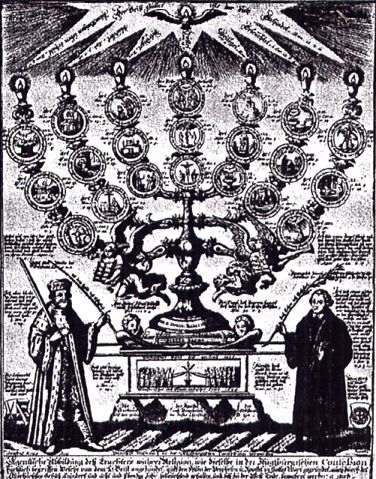
Strange contrast! Smith claiming that there is “no record that the Reformers made any such proclamation.” If such records are produced from scores of commentaries and works in mass, Editor Wilcox suggests, in order to uphold his august opinion, “a cutting out of all references to earlier interpretations of the three-fold message of Rev. 14!” Such apparent contradictions decided the present writer, in 1931, when, for a week he met with thirty-four leading Seventh-day Adventists, in Omaha, Nebraska, henceforth to stand for the truth as it is in Christ Jesus, foretold in prophecy, and its exact fulfillment recorded in the annals of historic truth, without regard to egotistical claims of any church or sect.
The above-named work, The Impelling Force of Prophetic Truth, most highly recommended by leading religious journals of Great Britain and of the United States of America, contains a picture of a silver coin struck in honor of Luther, representing him as the angel, given the very message “Babylon is fallen,” which I found at Wittenberg. During the centenary celebrations of the Reformation, in 1631, 1731, 1744, there were printed large editions of a picture representing the Lutheran Church as a candlestick, with the Bible underneath, and the Holy Spirit above; to the right, was Luther, and an angel sounding Revelation 14:6; to the left, was the Elector and over his head, Revelation 18:4, “Come out of her.”[4]
The identical picture of the candlestick of true religion as the same is, in short, represented in the Augsburg Confession, being anointed by the Holy Spirit, founded on the rock of the Apostles and Prophets in the word of God, also kept in clear light in view of the most secure protection during one hundred and seventy-eight years, and preserved until the end of the world. (See page 62).
Martin Luther and the Gospel of the Reformation
To what extent the gospel message of Revelation 14:6-12; and 18:4 ff., was the divine moving power of the Reformation is indicated by the preceding illustration which was used in the several celebrations of the Reformation in 1631, 1731, and 1744, with the various inscriptions printed in German and Dutch. From these Bible texts, it is clear that Luther proclaimed the everlasting gospel in its purity, and that the Elector of Saxony (Wittenberg) was the first ruler to take that step out of the spiritual Babylon.
The inscription at the bottom of the illustration reads as follows:
The identical picture of the candlestick of true religion as the same is, in short, represented in the Augsburg Confession, being anointed by the Holy Spirit, founded on the rock of the Apostles and Prophets in the word of God, also kept in clear light in view of the most secure protection during one hundred and seventy-eight years, and preserved until the end of the world.
The whole structure rests upon three mountains upon which is this inscription:
And are built upon the foundation of the apostles and prophets, Jesus Christ himself being the chief corner-stone. Ephesians 2:20.
Trampled underfoot in the foreground are the papistical errors condemned in the Augsburg Confession; namely,
Rejecting, or the refusal of, the cup at the Lord’s Supper; Compulsory celibacy of the priests; The Mass a Sacrifice; Compulsory auricular confession; Distinction of meats at festivals and fasts; Monastic vows; Secular domination by bishops to the spiritual disadvantage and corruption of the church.
On the face of the Ark of the Covenant, which rests on the summits of the three mountains, is shown the celebration of the conclusion of the “Münster-Osnabrucker Peace of 1649.” Above this is inscribed, “The Passau Treaty and Contract, 1555.” Upon the Ark rests the Holy Bible, with an angel at each end. Just above the Bible is written, “Law and Gospel.”
An inscription on the base of the candlestick proclaims that, “The Word of God rests in eternity.” Each of the seven branches of the candlestick, which is overshadowed by the Holy Spirit, in a triplet of pictures illustrates its several powers; namely,
Attracting, Enlightening, Sanctifying, Comforting, Strengthening, Preserving to eternal life.
The angel on the left, facing the Elector, holds in his hands the “Augsburg Confession.” Beneath this angel is written, “Behold, he that keepeth Israel shall neither slumber nor sleep. Psalm 121:4.” In his left hand, the Elector holds a rod, symbol of “Law, the staff of Moses the task-master.” Written along the rod, just above the Elector’s hand, appears, “To this I hold fast.” Beneath the rod and between the Elector and the end of the Ark, is inscribed,
That good thing which was committed unto thee keep by the Holy Ghost which dwelleth in us. 2nd Timothy 1:14.
Resting upon the ground beside the Elector, at his right, is the herald’s shield, above which is written, “The sword be my herald’s decoration. I fear not because God is with me.” To the left of the sword appears,
But continue thou in the things which thou hast learned and hast been assured of, knowing of whom thou hast learned them. 2nd Timothy 3:14.
Just above the point of the sword, as the real moving power concerning the outcome, is the following:
Come out of her [the spiritual Babylon], my people, that ye be not partakers of her sins, and that ye receive not of her plagues. For her sins have reached unto heaven, and God hath remembered her iniquities. Revelation 18:4-5.
On the right hand, opposite the Elector, stands Luther. Just above his herald’s shield on the ground at his left, is written, “My heart rests amid roses, but stands amid the cross.” Above this is inscribed,
For I have fought a good fight, I have finished my course, I have kept the faith: Henceforth there is laid up for me a crown of righteousness, which the Lord, the righteous judge, shall give me at that day: but not to me only, but unto all them also that love his appearing. 2nd Timothy 4:7-8.
In front of Luther, near the right-hand end of the Ark, is written the following:
Fear not, little flock; for it is your Father’s good pleasure to give you the kingdom. Luke 12:32.
Near the tip of the flowering olive branch which Luther holds in his right hand, is found, “The Gospel is signified by Aaron’s flowering olive branch. Number 17:8.”
Along the olive branch, from the hand upward, is written, “This I teach diligently.”
The angel on the right, looking downward toward Luther, holds in his right hand a book, entitled, “The Everlasting Gospel.” In his left hand, he holds a trumpet whence streams forth this message:
And I saw another angel fly in the midst of heaven, having the everlasting gospel to preach unto them that dwell on the earth, and to every nation, and kindred, and tongue, and people, saying with a loud voice, Fear God, and give glory to him. Revelation 14:6-7.
Herein it is unmistakably proven that Luther founded his work of the Reformation upon these divine messages in the 14th chapter of Revelation. And, as the papal abuses of his day remain until the present time, and to them has been added that of the Pope’s infallibility, this three-fold message, with its everlasting gospel preached in its purity, is as necessary today as the only means of salvation, as it was four hundred years ago. In leading German Bibles (Stuttgart’s edition, e. g.,) Revelation 14:6-7 is marked as one of the twelve texts for the festival of the Reformation. (Appendix, pp. 26, 16).
The Visions Questioned, and Finally Made A “Test”
James White tried his best to gain validity for the substitute of the 1847 tract; but, as long as a considerable number of copies existed, the omissions were questioned. Besides the Harbinger, there arose the “Messenger party,” who, in August, 1854, in the Messenger of Truth, sharply criticized the visions; so that James White, in the Review of October 16, 1855, (Vol. VII, p. 61) under the heading “A Test,” declared:
There is a class of persons, who are determined to have it that the Review and its conductors make the views of Mrs. White a Test of doctrine and Christian fellowship ….What has the Review to do with Mrs. W’s views? The sentiments published in its columns are all drawn from the Holy Scriptures. No writer of the Review has ever referred to them as authority on any point. The Review for five years has not published one of them …. It should be here understood that all these views as held by the body of Sabbath-keepers, were brought out from the Scriptures before Mrs. W. had any view in regard to them …. If we choose to believe Mrs. W’s views which harmonize with the Word, this is our business and nobody’s else.
But when the opposing party was turned down and separated, then a conference was called on November 16, 1855; and J. Bates was made chairman. The publishing plant was to be removed to Battle Creek, Michigan, and Brother White was to be subject to the advice of the financial committee. Bates, Cottrell, and J. H. Waggoner were “appointed to address the saints in behalf of the Conference, on the gifts of the church.” This committee recommended, on account of its good tendencies:
...to your candid consideration the contents of the book entitled ‘Experience and Views,’ believing them to be agreeable to the word of God, and the spirit of the Gospel. Dear Brethren, while we hold these views as emanating from the divine Mind, we would confess the inconsistency (which we believe has been displeasing to God) of professedly regarding them as messages from God, and really putting them on a level with the inventions of man. We fear that this has resulted from unwillingness to bear the reproach of Christ, and a desire to conciliate the feelings of our opponents, but the Word and our own experience have taught us that God is not honored, nor his cause advanced, by such a course.” “To say that they are of God, and yet we will not be tested by them is to say that God’s will is not a test or rule for Christians, which is inconsistent and absurd.
This report appeared, December 4, 1855 (pp. 78-79) in the first issue of the Review printed in Battle Creek, Uriah Smith being editor. Mrs. White’s earliest comment on this, entitled “Captivity Turned,” is quite suggestive:
At the Conference at Battle Creek …. God wrought for us. The minds of the servants of God were exercised as to the gifts of the Church. If God’s frown had been brought upon his people because the gifts had been slighted and neglected, there was a pleasing prospect that his smiles would again be upon us, and he would graciously revive the gifts again, and they would live in the church, to encourage the fainting soul, and to correct and reprove the erring. (Spiritual Gifts, II. 203.)
Her husband became so pliable that, in an article (p. 92), entitled “The Testimony of Jesus,” written under date of December 18, he made this new comment on Revelation 12:17:
Sabbath-keepers often quote this text, yet we think but few understand and realize its full import. There can be no doubt, but ‘the commandments of God,’ mentioned in this text, are the decalogue; but what is ‘the testimony of Jesus’? Men may give different answers; but it should be distinctly understood that the Bible gives but one answer, to this important question. Said the angel to John, ‘The testimony of Jesus is the spirit of Prophecy.’ (Revelation 19:10.)
Hitherto, Bible texts, e. g., I Peter 1:10; Revelation 1:19; 12:11, had served to give, even to the Whites, the correct interpretation, harmonizing Revelation 12:17 with Revelation 14:12, and stressing Revelation 19:10. “The Spirit, soul and substance of prophecy, is the testimony of Jesus.” (Life Sketches, p. 335). Henceforth, Mrs. White’s pen enjoyed the fullest liberty. When she pretended to have seen in vision what no one prophet ever saw – the main events since the fall of Satan until his destruction, -- Cottrell, the second member of the special committee, could set forth, in 1858, in a nine-page introduction, that the Seventh-day Adventists, as the remnant, had, according to Revelation 12:17; 19:10, in Mrs. White, “the testimony of Jesus.” (Spiritual Gifts, Vol. I, pp. 7-16). In 1860, in “Spiritual Gifts,” Vol. 2, she recorded anew her own experiences, views, and labor. Prefacing Vol. 3, Facts of Faith, in 1864, James White praised Spiritual Gifts as the great boon of Seventh-day Adventists above human creeds (pp. 9-32). But, strange to say, she here records in Chapter 6, entitled “Crime before the Flood,” the successful amalgamation of man and beast. As a result of her prolific writings, in Visions, 1868, Uriah Smith had to answer not less than fifty-two objections, the last one dealing with “suppressions;” but, instead of honestly confessing them, he made the matter worse by his puerile excuses.
The Misleading Preface of the Publishers, in 1881
The original unabridged edition of the early visions was published in 1847. In the edition of 1851, a number of very important omissions were made, which gave rise to serious objections. The long delay of the reprint caused the opponents “to make loud claims that there was a desire to suppress” important parts of her visions. A new edition finally became “imperative,” by 1881. But when the publishers, in full harmony with James White, wrote their preface, they dodged the real issue, calling the abridged edition of 1851 the original edition, instead of that of 1847, thus misleading the public by an intentional falsehood:
Footnotes giving dates and explanations …. will add to the value of this edition. Aside from these, no changes from the original work have been made in the present edition, except the occasional employment of a new word, or a change in the construction of a sentence, to better express the idea, and no portion of the work had been omitted. No shadow of change has been made in any idea or sentiment of the original work, and the verbal changes have been made under the author’s own eye, and with her full approval. PUBLISHERS.
The present writer, being asked in 1899 to provide the German edition with a preface, and having no knowledge of the 1847 edition, on the strength of this misleading preface, asserted that there had never been any omissions; and naturally called the edition of 1851 the original edition. But, in reality, important omissions from the original visions were perpetuated in the 1881 edition; the appearance of truth had been preserved, but at the cost of Christian honesty. The few remaining copies of the original 1847 edition were most carefully guarded, until Editor Woodward, of Portland, Maine, obtained the copy of G. W. Amadon long enough to photograph the omissions. His copy aroused me to question my successor, L. H. Christian, about the matter. Obtaining his original copy, I have since translated and published it in German, adding notes of explanations, and printing all omissions in heavy type.
But in spite of all information obtained from original documents found in libraries, proving that Mrs. White is a false prophetess, the former President of the Seventh-day Adventist, W. A. Spicer, nevertheless emphasized as late as 1929, in his Certainties of the Advent Movement, Washington, D. C., that Seventh-day Adventists accepted Mrs. White as an inspired prophetess. We find such sentiments as: “The Spirit of prophecy in the two movements,” the exodus and the Seventh-day Adventists (pp. 181-228). As Moses, the prophet, led Israel forth to the earthly Canaan, so the gift of prophecy by Mrs. Ellen G. White certainly leads the Seventh-day Adventists to the heavenly Canaan! “No years seem more marvelously to manifest the divine origin of this gift than those early years, when a young woman of seventeen and eighteen and onward was bearing messages.” But from those early visions from God, Seventh-day Adventists dare to drop out whole sentences; and, for years, have tried to hide the facts! How contradictory the Seventh-day Adventist position really is, the pamphlet, entitled, Divine Revelation the Prophetic Gift, written by F. M. Wilcox, chief editor of the Review, plainly reveals, when, on p. 32, he stresses the alternative: “The source of inspiration either from above or from beneath.” And yet he himself dares not to consider them “an Addition to the canon of Scripture.” If the following statement of his is correct, why not?
As Samuel was a prophet to Israel in his day, as Jeremiah was a prophet in the days of Captivity, as John the Baptist came as a special messenger of the Lord to prepare the way for Christ’s appearing, so we believe that Mrs. White was a prophet to the church of Christ today. And the same as the messages of the prophets were received in olden times, so her messages should be received at the present time.
Mrs. White is regarded as an equivalent, in every respect, to John the Baptist, even, the greatest of all the prophets; and yet her writings are unworthy “to be an addition to the canon of Scripture!” In her behalf, he even quotes Revelation 12:17; 19:10, on the title page. Why does he hesitate to draw from his premises the only possible conclusion? Because he is well aware that thousands of Seventh-day Adventists are not ready to accept such a conclusion. His hesitation confirms us in our own conclusions, drawn from all the other evidence; and, therefore, we do not hesitate to apply to Mrs. White the warning of our blessed Lord: “Beware of false prophets, who come to you in sheep’s clothing.”
Human Unscriptural Fallacies
- From 1840 until 1843/44, William Miller of New England assumed that “about the year 1843” Christ would clean the sanctuary by fire, thus creating, with Millennium, a new earth. When 1843 ended, he extended the time to the 21st of March, 1844, the Jewish New Year. When his assumption failed, he openly confessed it. (Spiritual Gifts, Vol. I., Pp. 96-101) Mrs. E. G. White “W. Miller, The First Angel’s Message” of Revelation” 14:6-7.
- From March 22 until October 22, 1844, S. S. Snow, gradually gaining a mighty influence over all Adventists, stressed, not only that all unbelievers of his message were fallen Babylon; but, by misinterpretation of Mark 13:32, claimed that the Father had revealed to him that the 22nd of October, 1844, was the definite date of
Christ’s coming to exchange the righteous and to destroy the wicked. A tarrying of six months (in reality over seven) was caused, as Ezra did not arrive in Jerusalem before the fifth month, and needed several months to start the rebuilding; but that the great date of delivery was the jubilee year of the atonement day. That this jubilee year was still years in the future, and that the Jewish day of atonement was on the 23rd day of September, did not matter to him. In order to gain
time, he adopted the reckoning of the Karaites, a small sect in Crimean Russia. After this new failure, he fixed the atonement day of 1845 as the right date. In her vision in December, Prophetess White, but seventeen years old, declared the midnight cry of Snow to be the bright light, giving the second
angel’s message. (Spiritual Gifts, Vol. I., pp. 101-108).
- As James White, with many other Adventists, was deceived in 1845 also, Crozier published his pamphlet in the 7th of February, 1846, claiming in a lengthy introduction and conclusion, that the entrance into the most Holy perhaps took place on the 22nd of October, 1846; but, within a year, he withdrew it all, placing the entrance into the most Holy in the future millennium. Mrs. White, by a vision, endorsed the pamphlet, April 27, 1847; but took off both legs and the head, and left it a lifeless trunk. (A Word, p. 12).
- In 1850, Captain J. Bates urged that the seven drops of blood were evidence of seven years duration. This the prophetess endorsed on June 27, 1850. Thus, both expected that Christ would come out of the most Holy in 1851. (Early Writings, pp. 54-57). As editor, James White doubted this, and proved its fallacy.
- In 1851, J. N. Andrews, along with James White, later with U. Smith also, attempted to prove that the two horned beast was to be realized in the United States of America; and that it would finally enforce a world-wide observance of Sunday as the mark of the beast, in contrast to the Sabbath as the seal of the living God. In this, the prophetess White saw the fulfillment of the third angel’s message in Revelation 14:9-12. (Spiritual Gifts, Vol. I, pp. 116-124). This view, endorsed by Prophetess White, and presented as the third message, has been accepted by the Seventh-day Adventist since 1851. Their numbers have increased to upwards of 400,000, and have spread over all the earth; but they are still waiting for its fulfillment. Fallacy after fallacy has been an outstanding mark in their history.
Divine Prophecies and Their Exact Fulfillment
- Before the foundation of the world, between the Father and Son, there was a covenant of grace, that in Christ by love we should be holy by faith. (Ephesians 1:4).
- Created perfect, Adam and Eve fell; but, as the first prophecy, they heard the gospel in Eden. Abel believed, and Enoch was translated. (Genesis 3:15; Hebrews 11:4-5).
- As the most perfect type of Christ, Melchizedek, being king of righteousness and peace and priest of the Most High, blessed Abraham. (Hebrews 7:1-4).
- Blessed, Abraham believed Christ’s power against hope, which was imputed to him for righteousness. God made the covenant of grace with Abraham 430 years before Sinai; and by oath insured the inheritance to him and Christ. (Romans 4:18-25; Galatians 3:14-48).
- As the angel of the covenant, Christ freed Israel from Egyptian bondage; Moses beholding his glory by faith. But Israel rejected salvation in Christ, and perceived not his perfect type in the continual lamb-offering; thus, Israel ended the bondage of the law; but the glory of the Most Holy remained hidden. (2 Corinthians 3:7-15); Galatians 4:24).
- Solomon turned to other gods in his old age, and Israel and Judah followed and defiled the sanctuary with most detestable idolatry; therefore, the temple was burned, and God’s hidden glory departed forever. Ezekiel set forth divine judgments in prophetic time; and, by the same standard, Daniel foretold the New Testament persecutions of the saints in three and a half times. The seven times (2,520 years) began with the Assyrian bondage of Israel, and form the perfection of mathematics, being exactly divisible by any of the ten numerals. (1 Kings 11:7-11; Ezekiel 4:6, 8:6; Daniel 7:25).
- Christ, “the wonderful numberer” (palmoni – margin – Daniel 8:13), enlightened the prophets so that they “testified before-hand” his sufferings and glory. In the seventy prophetic weeks, as the first part of the Sanctuary Cycle, covering 2300 years, the great atonement work of Christ was to be perfected, and at the end of the 2300 days “the sanctuary should be justified.” (1 Peter 1:10-12; Daniel 8:12 – margin: Hebrew, justified).[5]
- By divine instigation, King Cyrus and Darius agreed to rebuild; but not ere Artaxerxes so decreed, and sent Ezra at New Year, 457 B. C., when the seventy weeks, and, with them, the 2,300 years began. (Ezra 1:2; 6:1; 7:9-26). “Antiochus took away the daily sacrifice for a few years; the Romans for many ages, and cast down the temple;” thus Antiochus is but a weak type of the New Testament Antichrist during the long period of the apostasy in Western and in Eastern Rome. The Maccabees nowhere expressed hopes of Christ as the future Messiah.
- When Christ appeared in the flesh and lived a sinless life as the Lamb of God, the culmination of all prophecy was reached. The Baptist pointed to him as the Lamb of God, testifying “This is the Son of God.” John 1:29-34; Hebrews 10:9.
- When Christ died in the midst of the seventieth week, the atonement was finished by the one sacrifice, reconciliation for iniquity having been made, Christ brought everlasting righteousness, sanctified, was anointed as the most Holy at the resurrection, the disciples testifying that they beheld his glory, full of grace and truth. (Daniel 9:24; John 1:14).
- Christ sat down on the right hand of the Majesty on High, as our great high priest and king, after the everlasting order of Melchizedek. After his ascension the very image of the things came, and Christ as the Holy One, the author of life, became the chief corner stone of the temple, the apostles and prophets the foundation, and all believers the lively stones. (Hebrews 1:3; 7:21-28; Ephesians 2:20-22).
- On the day of Pentecost, the Twelve filled with the Holy Spirit, presented the name of Christ as the only salvation. Through their ministry, the 144,000 of natural Israel believed, were sealed as the first fruits to God and the Lamb, were marked in the book of the Lamb, having his and his Father’s names in their foreheads. (Acts 3:37-41; Revelation 7:4; 14:4).
- According to the solemn promise to Abraham, the gospel was given to the Gentiles by the ministry of Peter; they were filled with the Holy Spirit in Caesarea; and Barnabas, with Paul, raised up a large church at Antioch. Directly “by the Revelation of Jesus Christ,” Paul had received the full light of the gospel; and, on account thereof, circumcision and the ceremonial law ceased as shadows among the Gentiles. (Acts 10:34-48; 11:20-26; Galatians 1:12).
- The Judaizers tried to pervert the gospel at Antioch, and protested at the council at Jerusalem; but the Twelve, with Paul, set forth the truth. Under great persecutions, Paul cursed the perverters and exposed the mystery of iniquity. (Acts 15:1, 5, 24; Galatians 1:6-9; 2 Corinthians 11:2-15; 2 Thessalonians 2:7).
- Later on the part of the Gentiles the apostasy from the Moral Law, confirmed by the gospel, began with Constantine and fully developed in the papacy. (Daniel 7:25; 2 Thessalonians 2:3-6; Revelations 17:4-5).
- Gospel and Law being thus perverted, Christ sent forth four angels with trumpets of wrath against the Western Roman empire, overthrew it in 476 A. D., thus creating the deadly wound. (Revelation 8:7-12; 13:2-3).
- None of the ten rulers daring to claim the empire, the bishop of Rome quickly filled the vacant; and, in 533 A. D., Justinian, as emperor of the East, declared the bishop to be head of all the churches. The papacy helped to create, in 800 A. D., the German Roman empire; and by the great red dragon’s investigation, the deadly wound was healed; and the beasts out of the sea and out of the earth were ready for action. (Revelation 13).
- Under the first trumpet of woe, Mohammed appeared, Jerusalem was conquered; and, during five prophetic months, or 150 years, the Saracenic empire, with Baghdad as its capital, spread. Under the second woe, the Turks completed the subjugation of Eastern Rome, raising Constantinople as their capital in 1453 A. D. Their power was to last an hour, a day, a month, and a year, or 391 years, ending in 1844 A. D. (Revelation 9).
- Beginning with the 1260 years of apostasy, the Threefold Message, as a unit, sounded its warning, having the everlasting gospel to evangelize, warning against fallen Babylon and the mark of the Beast, threatened by Rome under capital punishment. As a sign of distress, the two witnesses prophesied during the 1260 years in sackcloth, the pure woman had to be shielded in the wilderness, and the Reformation could only stress the restoration of the perverted gospel; but true baptism and the true rest day
caused great distress. (Daniel 7:25; Revelation 7:14; 11:2-7; 12:14, 45; 13:7-18; 14:6-13).
- The Ancient of Days, having declared by oath that after 3 1/2 times, the power of the saints should no longer be broken, beginning with the French Revolution he poured out the seven vials of judgment against the wicked. But for the wise, Christ in his mercy instigated the great missionary movement. In 1792, the Baptist and the London missionary societies led out; and the British and the American Bible Societies followed, distributing many prophetic works. (Daniel 7:9-14; 12:4; Revelation 15, 16).
- From 1452 onward, prophetic expositors pronounced the 2,300 days as years. Pastor J. P. Petri of Seckbach fixed the commencement of the 70 year-weeks also as the beginning of the 2300 year-days, thus 457 B. C. – 1844 A. D. (Aufschlusz Zahlen Daniels und der Offenbarnog, p. 9). In London, the commentator Hans Wood (under
M. D.) fixed the same date in 1787; many followed, among them, the noted chronologist W. Hales (A New Analysis of Chronology, London, Vol. II, p. 517). In 1827, Mehemet Ali, being informed by his minister of war and he by the later Bishop Gobat of Jerusalem of the neat fall of Turkey out of Daniel, was about to subdue Turkey. In his dire need, the Sultan appealed to the great powers. As spokesman for the powers, England demanded, as the great issue, the abolition of capital punishment
of Christian converts from Islam, as set forth in the Koran. Finally, on the 21st of March, 1844, the Sultan decreed that, “The Sublime Porte engages to take effectual measures to prevent henceforth the execution and putting to death of the Christian who is an apostate.” E. Bickersteht, who with others had set the date Jewish New Year 1844, describes the fulfillment by full diplomatic references. (Practical Guide, London, Sept. 24, 1844, pp. 384-94).
- Beginning at the New Year 457 B.C., the persecuting papal power was broken at the end of 1260 years, and the Mohammedan power at the end of exactly 2300 years. Since then, the everlasting gospel is being freely preached as “a witness” in one thousand tongues to all the world. (Matthew 24:14). Christ’s oath in Matthew 24:14, is in full harmony with Daniel 12:7, that, after the 3½ times, the oppression of the saints would cease; and the oath in Revelation 10:6-7, that the time of oppression would be no longer; but that, at the beginning of the sounding of the seventh angel, the mystery of God as revealed in the everlasting gospel, “should be finished, as he had declared to his servants the prophets.” “Blessed,” indeed, is he who defends Truth as the most precious gift of Christ, and who heeds his admonition: “Behold, I come as a thief. Blessed is he that watcheth, and keepeth his garments, lest he walk naked, and they see his shame.” (Revelation 16:15).
L. R. Conradi.