Uncle Tom and Sister Ellen
By , last updated
Seventh-day Adventist [SDA] prophet Ellen G. White launched a crusade against fiction. According to White, novels and storybooks were not harmless entertainment but spiritual toxins capable of destroying faith, weakening the intellect, unbalancing the mind, and even driving readers insane. She warned SDAs to "put away every novel" and portrayed fiction as one of Satan's most effective tools for separating believers from God. Yet an examination of the historical record uncovers an astonishing irony: while publicly condemning fiction, White herself read it, collected it, preserved it in scrapbooks, kept novels in her private library, and even incorporated fictional material into her own "inspired" writings.
Supposed Dangers of Fiction
Ellen White frequently warned her followers about the horrendous dangers of reading fiction:
The readers of fiction are indulging an evil that destroys spirituality, eclipsing the beauty of the sacred page. It creates an unhealthy excitement, fevers the imagination, unfits the mind for usefulness, weans the soul from prayer, and disqualifies it for any spiritual exercise.1
Novel and story book reading are the greatest evils that youth can indulge in. Novel and love-story readers always fail to make good, practical mothers. They live in an unreal world. They are air-castle builders, living in an imaginary world. They become sentimental, and have sick fancies. Their artificial life spoils them for anything useful. They are dwarfed in intellect...2
Thousands are today in the insane asylum whose minds become unbalanced by novel reading, which results in air-castle building and love-sick sentimentalism.3
The world is flooded with novels of every description. Some are not of as dangerous a character as others. Some are immoral, low, and vulgar; others are clothed with more refinement; but all are pernicious in their influence.4
Even novels with positive morals and religious sentiments were frowned upon:
There is another class of books—love-stories and frivolous, exciting tales—which are a curse to every one who reads them, even though the author may attach a good moral. Often religious statements are woven all through these books; but in most cases Satan is but clothed in angel robes, to deceive and allure the unsuspicious. The practise of story reading is one of the means employed by Satan to destroy souls.5
According to this doctrine, all novels are pernicious. Reading fiction of any kind — called the "greatest" of "evils" — will have the following effects:
- Destroy spirituality
- Fevers the imagination
- Unfits the mind for usefulness and dwarfs the intellect
- Unbalances the mind and make people go insane
- Weans the soul from prayer
- Disqualifies the soul for any spiritual exercise
- Unfits women from being good mothers
- Spoils people for anything useful
This sounds very serious indeed! White instructed SDA youth that they "should keep the mind pure by avoiding the reading of novels" and to "cease to read the magazines containing stories. Put away every novel."6 This was a demand for complete abstinence. White condemned fiction categorically, portraying it as a menace to spirituality, morality, and even mental health. If her testimonies are to be believed, faithful SDAs should have purged their homes of virtually every work of fiction ever written. Such extreme warnings naturally invite scrutiny. Did Ellen White herself obey the standard she so forcefully imposed on others, or did she operate by a very different set of rules?
White's Hypocrisy Exposed
Ellen White had an interesting practice. She clipped out stories from magazines she was reading, and she made scrapbooks of those articles. She made nine scrapbooks of such clippings. Dr. John Waller of Andrews University analyzed the contents of five of those scrapbooks and reported his findings:
...most of the stories were anonymous, that many of them were fiction, and that a few of them were by recognized and well-known fiction writers of her time, including Hans Christian Andersen, who is noted for his fairy tales, and Harriet Beecher Stowe, the author of Uncle Tom's Cabin. Dr. Waller reached the conclusion that 'On the evidence of the scrapbooks and Sabbath Readings . . . between 1850 and 1880 she herself read and preserved for future reference many relatively short, . . . non-factual stories that appeared in various magazines...7
White was secretly reading fiction in magazines and making scrapbooks of it for future use, while she was publicly telling the youth to "cease to read the magazines containing stories." Perhaps one of the reasons she did not want the youth reading such magazines is because she was incorporating fictional accounts into her "inspired" writings.
Although she told the youth to "put away every novel," she called John Bunyan's novel, Pilgrim's Progress, "wonderful" in The Great Controversy.8 Does Ellen White's endorsement of Bunyan's fictional story instruct her followers that fiction is okay to read as long as it teaches good lessons? Not according to the prophetess:
Even fiction which contains no suggestion of impurity, and which may be intended to teach excellent principles, is harmful. It encourages the habit of hasty and superficial reading, merely for the story. Thus it tends to destroy the power of connected and vigorous thought; it unfits the soul to contemplate the great problems of duty and destiny.9
White's own behavior demolished her testimony. While ordinary SDAs were told to "put away every novel," the prophetess quietly read, collected, and endorsed fiction herself. Evidently, the spiritual poison she warned others about somehow lost its toxicity when she handled it.
White Copies "Fiction" into Her Own "Inspired" Writings
Notice how White describes her books as sources of "truth":
The larger books, Patriarchs and Prophets, The Great Controversy, and The Desire of Ages, should be sold everywhere. These books contain truth for this time,—truth that is to be proclaimed in all parts of the world.10
Where did White obtain the wonderful "truth for this time?" From heavenly visions? Revelations? Dreams? No, not exactly. She obtained at least some of her "inspiration" from the same fictional writings that she told others to avoid!
Perhaps the most embarrassing example involves John Milton's epic poem, Paradise Lost. Milton's work is not history; it is religious fiction—a seventeenth-century poetic retelling of the Fall filled with imaginative scenes, invented dialogue, and extra-biblical details. Yet many of the vivid "visions" found in Patriarchs and Prophets closely parallel Milton's fictional narrative. White reproduces Milton's winged serpent of "burnished gold," Satan's post-fall council meeting, the separation of Adam and Eve before the temptation, and even Adam's panoramic vision of future history.11 Ironically, while White warned that fiction "unfits the soul to contemplate the great problems of duty and destiny," she appears to have been mining one of Christianity's most famous works of religious fiction for material to include in books she claimed contained "truth for this time."
In 1982, Dr. Fred Veltman, then chairman of the religion department of Pacific Union College, was asked by the SDA Church to analyze the charges of plagiarism brought by Walter Rea and others against Ellen White. Veltman spent eight years — at church expense — studying The Desire of Ages. When he finally published his findings in 1990, he announced that one of the 23 sources White used in writing the book was an "obviously fictional account."12
Many people, even among SDAs, now regard the prophetic sections of Great Controversy as largely fictional. They map out an end-time scenario of death decrees for those who refuse to worship on Sunday — a scenario that now seems far-fetched.
More examples of White's use of fictional material in her writings can be found in Walter Rea's, The Making of a Prophet: How Ellen White turned FICTION into "truth".
White Helped Put Together Fictional Books
Ellen White was directly involved in the production of the 4-volume SDA series called Sabbath Readings for the Home Circle. Each story book was 400-pages in length and was made up of fictional stories intended to inspire moral behavior. White personally selected all of the fictional material to include in the books. Undoubtedly these were better than the average novel of the 1800s, and yet they still embodied what White had earlier condemned: "Novel and story book reading are the greatest evils that youth can indulge in. ... They live in an unreal world...an imaginary world."13
White Owned Novels
Ellen White instructed her followers, "Novels should never be brought into the home, for a snare is laid in so doing" and "Novels should not find a place in the homes of those who believe in Christ."14 Based on these strong statements, one would not suspect that White had novels in her personal or office libraries where they could become a "snare" to others. However, a careful review of White’s libraries reveals a distinct selection of 19th-century moral fiction, domestic tales, and historical romances.15
Below are her books that are classified as novels, fictional tales, or collections of moral stories:16
| Author | Title & Publication Details | Classification Notes |
|---|---|---|
| Aguilar, Grace | Home Influence; a Tale for Mothers and Daughters (NY: Harper & Brothers, 1851) | Designated a "Tale"; a domestic novel by a well-known Victorian fiction writer. |
| Anonymous | Home Scenes; or, Lights and Shadows of the Christian Homes (NY: Amer. Tract Soc., 1864) | A collection of fictionalized moral and domestic sketches. |
| Anonymous | In the World, but Not of the World (NY: Episcopal Sunday School Union, 185?) | A didactic religious tale in narrative fiction format. |
| Anonymous | Kind Words; A Collection of Stories (Boston: Sabbath School Soc., 1861) | Explicitly cataloged as a collection of fictional moral stories for children. |
| Anonymous | Kind Words Awaken Kind Echoes: or, Illustrations of the Power of Kindness (London: T. Nelson & Sons, 1858) | A collection of illustrative moral narrative tales in fiction form. |
| Anonymous | Kind Words for His Young Friends, by Uncle William (Phila.: Presbyterian Board of Publications, 1844) | A didactic children's fiction narrative, published under a pseudonym. |
| Anonymous | Martha's Home (NY: Thos. Nelson & Son, 187?) | A domestic narrative fiction tale in Nelson's juvenile fiction series. |
| Anonymous | Mirror of the Soul; or, Spiritual Things Discerned (Auburn, NY: Alden, Beardsley, & Co., 1852) | A narrative fiction work of spiritual allegory in the Bunyan tradition. |
| Anonymous | The Moss Rose, A Christmas and New Year's Present, 2 vols., ed. S. G. Goodrich (NY: Nafis and Cornish, 1846–1848) | An annual gift-book anthology of short fiction, poetry, and tales. |
| Anonymous | Scenes in Switzerland. Gretchen. A Night in the Cathedral. The Bride of the Aar. (NY: Amer. Tract Society, 1868) | A volume of short fictionalized narrative stories. |
| Anonymous | Steps in the Dark (Edinburgh: Oliphant, 1863) | A religious narrative fiction piece from a firm specializing in evangelical story-fiction. |
| Anonymous | Which, the Right or the Left (NY: Garrett, Dick, Fitzgerald & Co., 1855) | A widely circulated 19th-century social and religious novel. |
| Anonymous | Willard Prime (Boston: Tilton & Co., 1864) | A didactic moral fiction narrative for youth. |
| Anonymous | Women of Worth: a Book for Girls (NY: W.A. Townsend, 1861) | A collection of didactic moral stories and fictionalized biographies. |
| Arthur, Timothy S. | Arthur's Household Library, 12 vols. | Multi-volume collected works of T.S. Arthur's domestic and temperance fiction. |
| Arthur, Timothy S. | Home Lights and Shadows (NY: C. Scribner, 1853) | A collection of fictionalized moral and domestic tales. |
| Arthur, Timothy S. | The Lights and Shadows of Real Life (Phila.: J.E. Potter & Co., 1867) | A collection of narrative moral sketches; confirmed fiction in Arthur's tradition. |
| Arthur, Timothy S. | Stories for Parents, Vol. 8 of Arthur's Library for the Household (NY: J.W. Lovell, 1885) | A collection of didactic domestic stories. |
| Arthur, Timothy S. | Woman to the Rescue (Phila.: J.M. Stoddard & Co., 1874) | A classic 19th-century temperance novel. |
| Arthur, Timothy S., ed. | Words of Cheer for the Tempted, the Toiling, and the Sorrowing (Phila.: H.C. Peck & T. Bliss, 1861) | An anthology of uplifting moral tales and narrative fiction. |
| Baker, Harriette N. ("Mrs. Madeline Leslie") | Every Day Duties; or the Schoolmates (Boston: Henry Hoyt, 1864) | Under her fiction pseudonym; an exclusively-fiction author's children's novel. |
| Brownlee, William C. | Lights and Shadows of Christian Life (NY: John S. Taylor, 1847) | A collection of didactic fiction tales ("The General," "The General's Widow; or Grace triumphing over Scepticism," etc.), confirmed by bookseller records. |
| Bungener, Laurence L. | The Priest and the Huguenot; or, Persecution in the Age of Louis XV, 2 vols. (Boston: Gould & Lincoln, 1853) | Confirmed historical fiction (Library of Congress, Internet Archive, Auburn Univ.). |
| Dayton, Amos Cooper | Theodosia Earnest; or, The Heroine of Faith, 2 vols. (NY: Sheldon Blackman & Co., 1857) | A famous Baptist controversy novel; Dabney's rebuttal was titled Fiction, No Defence of Truth. |
| Dixon, Thomas | The Clansman (NY: Doubleday, Page & Co., 1907) | Historical romance novel; full subtitle An Historical Romance of the Ku Klux Klan. |
| Dixon, Thomas | The Leopard's Spots; a Romance of the White Man's Burden (NY: Grosset and Dunlap, 1902) | Explicitly a "Romance"; first novel in Dixon's Reconstruction trilogy. |
| Dixon, Amzi Clarence | Lights and Shadows of American Life (NY: Fleming H. Revell, 1898) | A collection of narrative sketches/tales in the "Lights and Shadows" fiction-sketch tradition. (Borderline — sketches with strong narrative-fiction character.) |
| Dodge, Mary A. ("Gail Hamilton") | Skirmishes and Sketches (Boston: Ticknor & Fields, 1865) | Literary sketches/essays under a literary pseudonym. (Borderline — belletristic.) |
| Edgeworth, Maria | The Parent's Assistant (NY: Hurd & Houghton, 1869) | Famous children's fiction collection (1796) by the celebrated Anglo-Irish novelist. |
| Elliott, S. H. | Lights and Shadows of a Pastor's Life (NY: Derby and Jackson, 1857) | Confirmed fiction; bookseller records state "it was all fiction" — a novel of a fictional minister's life set in New England/New York. |
| Holland, Josiah G. ("Timothy Titcomb") | Letters to the Joneses (NY: C. Scribner, 1863) | Fictional epistolary narratives addressed to fictional recipients. (Borderline.) |
| Ingraham, Joseph H. | Throne of David (Phila.: G.C. Evans, 1860) | Biblical historical novel; third in Ingraham's "Hebraic Power Trilogy" of epistolary biblical fiction. |
| Marshall, Emma | Dewdrops and Diamonds (NY: Robert Carter & Bros, 1881) | A novel by Emma Marshall, an exclusively-fiction author of Victorian juvenile/domestic novels. |
| Moore, Mrs. H. J. | Golden Legacy; a Story of Life's Phases (NY: D. Appleton and Co, 1857) | A novel ("A Story of Life's Phases"), confirmed by multiple catalog records. |
| Myers, Sarah Ann | The Baron's Children (Phila.: Lindsay and Blakiston, 1900) | A juvenile fiction title; a children's novel. |
| Piatt, Louise | Bell Smith Abroad (NY: J.C. Derby, 1855) | A travel-themed narrative novel; cataloged under Fiction by HathiTrust/Forgotten Books. |
| Pollok, Robert | Tales of the Covenanters (Edinburgh, London: Oliphant, Anderson and Ferrier, n.d.) | Confirmed fiction: a collected trilogy of historical tales (Helen of the Glen, Ralph Gemmell, The Persecuted Family). |
| Power, Philip Bennett | Moss Rose, vol. 3 of Moss Rose Stories (Boston: Amer. Tract Soc., 1876) | An American Tract Society fictional moral narrative, part of a "Stories" series. |
| Tayler, Charles B. | May You Like It (Phila.: J. Conrad, 1822) | A series of stories by an evangelical novelist; the author's first fiction work. (Leans fiction; partly essayistic.) |
| Tonna, Charlotte Elizabeth | Personal Recollections (NY: J.S. Taylor & Co., 1845) | Autobiography by a novelist, described by scholars as "part memoir, part travelogue, part near fiction." (Borderline.) |
| Tonna, Charlotte Elizabeth, ed. | Protestant Christian Keepsake (London: Baisler, 1840) | A gift-book annual containing short fiction, tales, and poems. (Borderline.) |
| Wallace, Mrs. Lew (Susan Arnold) | The City of the King; What the Child Jesus Saw and Heard (Indianapolis: Bobbs-Merrill, 1903) | Biblical narrative fiction by Susan Wallace, wife of Ben-Hur author Lew Wallace. |
| Walshe, Elizabeth H. | Within Sea Walls; or How the Dutch Kept the Faith (NY: Board of Publication, Reformed Church of Amer, 186?) | Cataloged by the Library of Congress explicitly as "Historical fiction" (Inquisition/Netherlands). |
| Wilson, John | Lights and Shadows of Scottish Life (NY: Robert Carter and Bros., 1851) | Confirmed fiction: a famous collection of 24 short stories by John Wilson ("Christopher North" of Blackwood's), first published 1822. |
While Ellen White publicly castigated fiction as a soul-destroying vanity and a satanic diversion designed to erode spiritual life, her private library exposes a glaring double standard. The presence of multi-volume domestic tales, historical romances, and didactic novels by authors like T.S. Arthur and Thomas Dixon reveals a profound chasm between her rigid public asceticism and her private consumption. For a prophet who aggressively warned her flock that novel-reading was a moral pathogen, harboring these very texts on her own shelves moves past simple irony into blatant hypocrisy—proving that the strict prohibitions she engineered for her flock were quietly ignored by her within the comfort of her own study.
Racist Novels in White's Personal Library
Among the works of fiction cataloged in White's library are two of the most virulently racist novels in American publishing history:
- The Leopard's Spots: A Romance of the White Man's Burden, by Thomas Dixon (1902)
- The Clansman: An Historical Romance of the Ku Klux Klan, by Thomas Dixon (1905)
Thomas Dixon Jr. was no ordinary novelist. Wikipedia describes him as "an American white supremacist" who is characterized by scholars as a "professional racist."17 His father and uncle were members of the Ku Klux Klan. Both novels belong to Dixon's "Trilogy of Reconstruction," which Wikipedia summarizes as follows:
Dixon's novels were best-sellers in their time, despite being racist pastiches of historical romance fiction. They glorify an antebellum American South white supremacist viewpoint. Dixon claimed to oppose slavery, but he espoused racial segregation and vehemently opposed universal suffrage and miscegenation. He was 'a spokesman for southern Jim Crow segregation and for American racism in general.'17
The content of these novels is not merely dated or insensitive by modern standards — it was extreme and inflammatory even by the standards of its own era.
The Leopard's Spots takes its title from Jeremiah's rhetorical question, "Can the leopard change his spots?" — Dixon's answer being that Black Americans could no more change their supposedly inferior nature than a leopard could change its markings. Wikipedia notes that in the novel, "Dixon offers a very unreconstructed account of Reconstruction, in which the villains are Northern liberals and emancipated slaves, and the hero is the Ku Klux Klan."18
The Clansman is more inflammatory still. Wikipedia describes it as written to convince Northerners to maintain racial segregation, with the work claiming that "blacks when free turn savage."19 It portrays Black men as sexual predators threatening white womanhood, depicts Klansmen as heroic defenders of civilization, and glorifies racial violence as the salvation of the South. It was this novel that D. W. Griffith adapted into The Birth of a Nation (1915) — a film that directly inspired the 20th-century revival of the Ku Klux Klan.
Ellen White's ownership of these books cannot be brushed aside as coincidence or ignorance. These were not obscure pamphlets tucked into a forgotten corner — they were prominent, bestselling novels whose racial ideology was loudly advertised in their very titles. The Clansman was a cultural phenomenon. Their content was well known. And yet both sat in the private library of the woman who wrote, "The practice of story-reading is one of the means which Satan uses to destroy souls." Ellen White thundered against fiction while quietly keeping on her own shelves two of the most poisonous novels of the Reconstruction era — books whose purpose was to dehumanize Black people, glorify domestic terrorism, and sustain the ideology of white supremacy.
One is left to wonder: if fiction was so spiritually deadly, why were these particular books deemed worth keeping?
White blasts Uncle Tom's Cabin, Robinson Crusoe
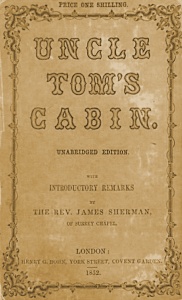
Ellen White's war on fiction knew few boundaries. Any Christian could certainly agree wholeheartedly with her for denouncing immoral or salacious literature. What is most shocking, however, is that she attacked some of the most respected and morally uplifting books ever written. Among her targets were Harriet Beecher Stowe's Uncle Tom's Cabin—the novel widely credited with helping bring an end to American slavery—and Daniel Defoe's Robinson Crusoe, a classic celebrated for its themes of faith, repentance, and divine providence. Astonishingly, White classified the recommendation of such books as evidence of defective spiritual judgment and warned that reading them was part of "Satan's work."
Ellen White makes it abundantly clear that Uncle Tom's Cabin and Robinson Crusoe are 1) evil, 2) Satan's work, and 3) destroy interest in the Bible:
Dear Brother E: I have just read the Review and Herald and have seen your article giving a list of good books for our youth. I was much surprised to read your recommendation of Uncle Tom's Cabin, Robinson Crusoe, and such books. You are in danger of becoming somewhat careless in your writing. It would be well to give thought and careful study to whatever is to be immortalized in print. I am really alarmed to see that your spiritual eyesight is not more clear in the matter of selecting and recommending reading for our youth. I know that the recommendation in our papers of such infatuating books as Uncle Tom's Cabin will in many minds justify the reading of other books which are nothing but fiction. . . . I have repeatedly seen the evil of reading such books as you recommend, and have an article all prepared, cautioning our youth in this very matter. ... But I hope no more such recommendations will appear. You must be getting away from Jesus and His teachings and do not realize it. It is Satan's work to present to our youth newspaper stories and storybooks that fascinate the senses and thus destroy their relish for the word of God.20
Mrs. White expounds further upon the great dangers of reading Uncle Tom's Cabin, writing that it...
- Destroys interest in the Bible
- Destroys interest in prayer meetings
- Causes evil imaginations
- Leads to immorality
- Leads to disobedience
- Leads to deception
It has destroyed appetite for the Bible, and the desire to attend prayer-meetings; for everything was stale and without interest after feasting upon the diet found in this book. The food taken into the mind was of such a character that heavenly and divine things found no place in the thoughts, and the imaginations were evil, and these youth have made confessions that this was caused by the reading of Uncle Tom's Cabin. This laid the foundations for a train of evils, and the imaginations became intensely excited, and the thoughts would recur again and again to immoral subjects which led to sin of licentiousness and impurity, to disobedience, to secret plannings, and to deception.21
That is quite an astonishing array of evil caused by one book! Is Uncle Tom's Cabin indeed such a harmful book?
Uncle Tom's Cabin is a novel that "depicts the cruel reality of slavery while also asserting that Christian love can overcome something as destructive as enslavement of fellow human beings."22 The book was partly inspired by the true story of a slave named Josiah Henson. The book, written by a teacher from Connecticut named Harriet Beecher Stowe, helped to fuel the abolitionist movement that eventually led to the end of slavery in the United States. Mrs. Stowe became an icon of freedom in the northern United States, and President Abraham Lincoln met with her prior to the start of the American Civil War. This immensely popular book became the second best-selling book in the world during the 19th century (following only the Bible), with the book being translated into every major human language.23 There is no doubt this book was the most important book written in the 19th century.
Like Uncle Tom's Cabin, Robinson Crusoe is hardly the sort of book one would expect a Christian leader to denounce. First published in 1719, Daniel Defoe's classic tells the story of a shipwrecked sailor who, after years of self-reliance and spiritual indifference, is brought face-to-face with his own sin and dependence upon God. Alone on a deserted island, Crusoe reads the Bible, repents of his past life, acknowledges God's providence, and develops a deep and abiding faith. Far from leading readers away from spiritual things, the book repeatedly emphasizes prayer, repentance, gratitude, divine providence, and trust in God during times of adversity.
For more than three centuries, Robinson Crusoe has been regarded as one of the greatest works in English literature. It has inspired countless readers with its themes of perseverance, industry, personal responsibility, and spiritual renewal. Indeed, many Christian parents and educators have intentionally placed the book in the hands of young people precisely because of its strong moral and religious lessons. That Ellen White could classify such a work as spiritually dangerous and even associate it with "Satan's work" reveals just how extreme and fanatical her crusade against fiction had become.
Do Aesop's Fables Destroy Spirituality?
In 1902, Ellen White wrote that reading Aesop's Fables would start young people on a downward progression that would result in them losing their spirituality:
Years ago, reproof was given our editors in regard to advocating the reading of even such books as Uncle Tom’s Cabin, Aesop’s Fables, and Robinson Crusoe. Those who begin to read such works usually desire to continue to read novels. Through the reading of enticing stories they rapidly lose their spirituality. This is one of the principle causes of the weak, uncertain spirituality of many of our youth.24
Aesop's Fables contain timeless stories offering lessons that help children grow intellectually, morally, and socially. Each fable contains a moral or life lesson (e.g., "slow and steady wins the race" from The Tortoise and the Hare), encouraging children to reflect on the importance of virtues like honesty, kindness, patience, and humility. The stories break down ethical concepts into simple narratives that are easy for children to understand and internalize. The fables illustrate how actions have consequences, helping children consider the impact of their behavior on others. Practical lessons like "don’t be greedy" (The Goose That Laid the Golden Eggs) or "help others and they’ll help you" (The Lion and the Mouse) are universally relevant, guiding children to navigate relationships and challenges in daily life. For example, in the story of the Ant and the Grasshopper, children learn the importance of preparation and hard work, while The Fox and the Grapes teaches them to handle disappointment gracefully. These lessons equip children with wisdom they can apply throughout life.
Reading Aesop's Fables provides children with valuable lessons, develops positive character traits, and instills timeless values that can guide them through life. It is bewildering as to why Ellen White imagined this book to be dangerous to SDA youth!
Reading Novels Causes Insanity? Destroys Memory?
Ellen White's crusade against fiction eventually crossed the line from spiritual counsel into medical absurdity. She did not merely claim that novels were spiritually harmful; she insisted that they could ruin the mind, destroy the memory, cause insanity, and even leave readers physically paralyzed. If these warnings came from divine revelation, modern science should confirm them. Instead, contemporary neuroscience and psychiatry have overwhelmingly reached the opposite conclusion. White's alarming predictions stand today as yet another example of nineteenth-century speculation being presented as inspired truth.
Mrs. White wrote that reading fiction could unbalance the mind, damage memory, and cause paralysis:
"That mind is ruined which is allowed to be absorbed in story-reading. The imagination becomes diseased, sentimentalism takes possession of the mind, and there is a vague unrest, a strange appetite for unwholesome mental food, which is constantly unbalancing the mind. Thousands are today in the insane asylum whose minds became unbalanced by novel reading, which results in air-castle building and love-sick sentimentalism."25
"The memory is greatly injured by ill-chosen reading, which has a tendency to unbalance the reasoning powers and to create nervousness, weariness of the brain, and prostration of the entire system."26
Some youth, and even some of mature age, have been afflicted with paralysis from no other cause than excess in reading. The nerve power of the brain was kept constantly excited, until the delicate machinery became worn, and refused to act. Some of its fine mechanism gave way, and paralysis was the result. There are men and women now in the decline of life who have never recovered from the effects of intemperance in reading.27
Does fiction unbalance the mind? Does it make people insane? Does it injure memory? Does it cause paralysis? On the contrary, not only does reading fiction reduce stress, but it has other mental health benefits as well. Reading fiction has been shown to strengthen the mind, and in some ways, even more than non-fiction reading. In 2013, Emory University examined the minds of fiction readers and found:
- The brains of fiction "readers showed more activity" in areas of the brain "associated with understanding language."28
- The website testyourvocab.com analyzed millions of its test-takers and found "fiction readers were significantly more likely to have a larger vocabulary" suggesting "reading fictional literature could lead to better procedures of processing information generally, including those of creativity."29
Scientific Evaluation of Ellen White's Novel/Fiction Statements
"That mind is ruined which is allowed to be absorbed in story-reading... unbalancing the mind. Thousands are today in the insane asylum whose minds became unbalanced by novel reading..."
 Scientific Verdict: Inaccurate
Modern psychiatry and neuroscience completely reject the notion that reading fiction or novels causes psychosis, schizophrenia, or clinical insanity. Neuroimaging studies show that reading stories engages complex neural networks, actually improving empathy, emotional regulation, and social cognition. It is highly probable that 19th-century asylum patients who obsessively read fiction were exhibiting early symptoms of pre-existing psychiatric conditions—withdrawing into books as a coping mechanism—rather than the books causing their illnesses.
"The memory is greatly injured by ill-chosen reading, which has a tendency to unbalance the reasoning powers..."
Scientific Verdict: Inaccurate
Engaging with narrative text does the exact opposite of injuring the memory; it requires the brain to track complex characters, plotlines, and themes, which exercises and strengthens working memory and cognitive reserve. Longitudinal studies demonstrate that mentally stimulating activities like reading delay cognitive decline and memory loss in older adults. While reading highly distressing material can cause temporary emotional stress or fatigue, it does not physically damage reasoning powers.
"Some youth, and even some of mature age, have been afflicted with paralysis from no other cause than excess in reading."
Scientific Verdict: Completely Inaccurate
From a modern neurological standpoint, reading cannot cause strokes, motor neuron destruction, or physical paralysis. Paralysis is caused by structural damage to the central nervous system, such as a stroke (blocked or ruptured blood vessels), spinal cord trauma, tumors, or neurodegenerative diseases (like ALS or MS). Intense mental focus or reading does not wear out the physical tissue of the brain to the point of structural failure or physical immobility.
If Ellen White truly received these warnings from God, one would expect modern science to confirm them. Instead, neuroscience and psychiatry have reached precisely the opposite conclusion: reading fiction generally benefits rather than harms the mind. The evidence suggests that White was not transmitting divine revelation, but repeating the unfounded health speculations of her Victorian age.
Conclusion
Does reading Robinson Crusoe really destroy a person's interest in the Bible? Is Harriet Stowe's Uncle Tom's Cabin really that terrible? One must wonder, because Mrs. White later clipped stories written by Stowe and put them into her scrapbooks.
It is astonishing that White condemned the reading of Uncle Tom's Cabin &mdash an anti-racist book written by a Christian encouraging the end of slavery, with a foreword written by an ordained minister of the gospel — and yet she kept the racist novels The Clansman and The Leopard's Spots in her own private library.
Today, many SDAs are perplexed as to why she called for "total abstinence" from fiction, even high class fiction?30 After all, Jesus spoke in parables to his disciples. Even Sister White did not seem to believe her own testimonies about fiction because she contradicted them by...
- Clipping out fictional stories she had read and saving them in scrapbooks
- Incorporating fiction into her "inspired" books
- Keeping works of fiction in her personal library
Why would she do that if she really believed that novels destroy spirituality, weaken the intellect, unbalance the mind, ruin the memory, cause insanity, and even produce paralysis. Why didn't she follow her own instructions to "put away every novel" since they were one of Satan's chief methods for destroying souls?
Even more troubling, many of White's most detailed visions bear striking similarities to literary works such as Paradise Lost. If, as White claimed, fiction has the power to excite the imagination, blur the line between reality and fantasy, and implant vivid mental images, then one cannot help but ask an uncomfortable question: Was Ellen White herself influenced by the very fictional literature she condemned? Did the imaginative works she read shape what she later sincerely believed she had seen in vision?
Ironically, Ellen White warned that novels could produce diseased imaginations, unrealistic mental worlds, and distorted perceptions of reality. If her warnings were true, perhaps they explain not the downfall of her readers, but the origin of her own prophetic career. The evidence suggests that the prophetess who thundered against fiction may have been one of its most influential victims.